
Conference on Bajau Laut in Semporna 23-27 April
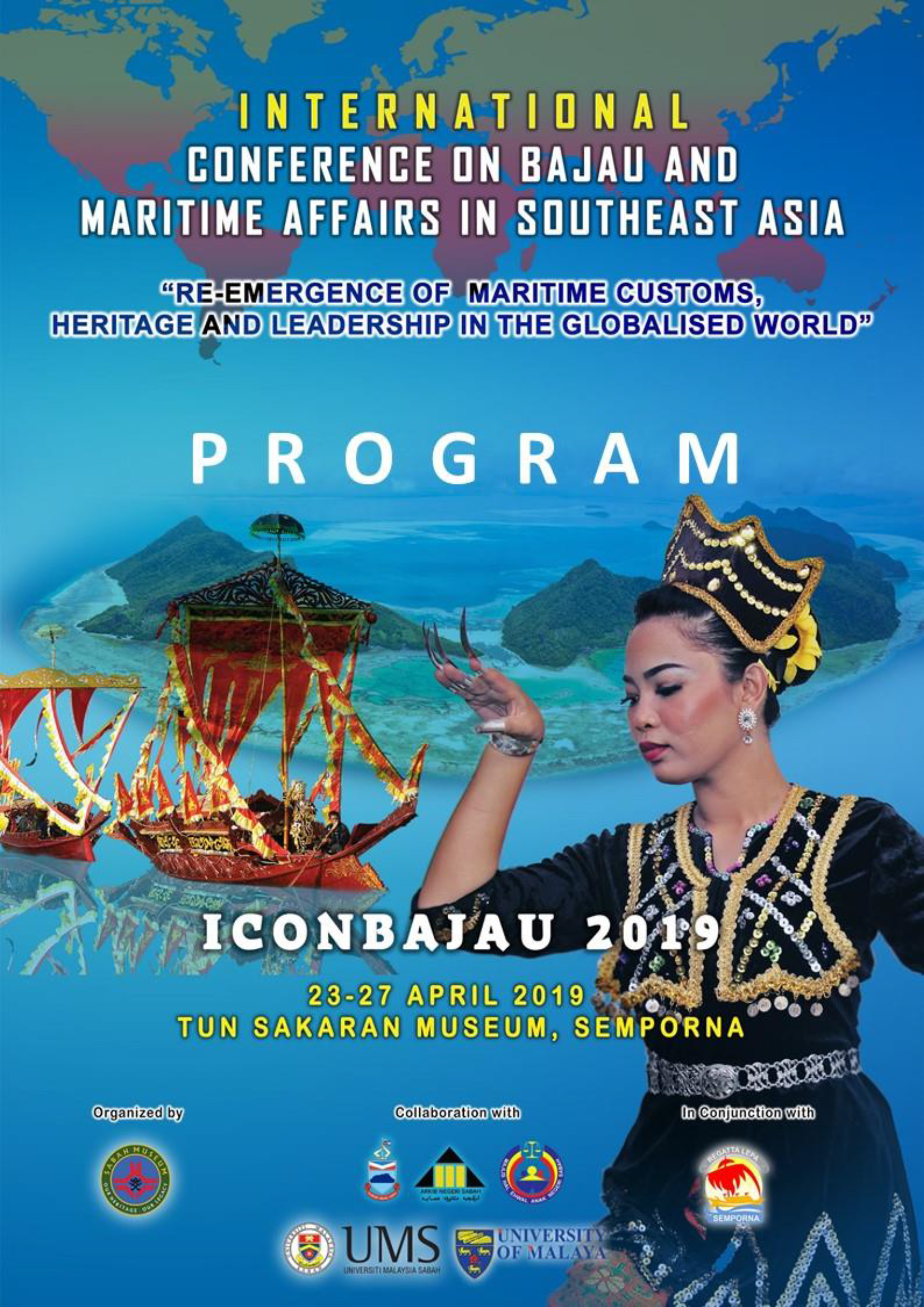
Between 23-27 April a new international conference on the Bajau Laut will be held in connection with the annual Regatta Lepa Festival in Semporna. The conference will focus on the the re-emergence of maritime customs in a globalized world.
You can find the program here: The International Conference on BajauSama Maritime Affairs of Southeast Asia (ICONBAJAU2019).
The Making of a Documentary in Semporna – a Story of Contradictions
In mid-December I assisted a film crew from Radio Television Hong Kong (RTHK) in the production of a documentary movie about the Bajau Laut in Semporna. During ten busy days we followed three Bajau Laut families in Bodgaya, Mabul and Bangau-Bangau, one boat living family, one family in a stilt house and one more integrated family in Semporna. In the process I got more insights about the life of the Bajau Laut – and its contradictions.
A Stroll in the Morning Fish Market
In the first day of the production we entered the busy fish market early in the morning. Next to a huge pile of shell I met a young Bajau man from Bangau-Bangau who were waiting for fishermen with catches of live fish. Every time a fisherman arrived with a fresh catch, he jumped on to the boat to see what they had caught, and after some time he bought a large grouper for 50 ringgit that he tied to a stick and kept in the water near the pile. “I will wait till afternoon and then I will sell it to Chinese tourists”, he said. “I can get around 100 ringgit for the live grouper”.
At the same time a group of fishermen brought two big dead manta rays to the shoreline. One of the fishermen cut the manta rays in half and handed over them to two young men with wheel barrows. Shortly thereafter the manta rays were put in ice and loaded upon the board of a small van. Everything happened quickly, so I guessed that the bargaining must have taken place on the boat before they hit land. I also noticed that people in the market made no or little notice of the rare manta rays. After some time, I contacted one of the fishermen who had caught the manta rays and asked him about the price. First, he seemed to regret that he had just sold the manta rays, but when he understood that I was not interested in buying them he said that he had sold them for 150 ringgit each, before he hurried away.
One young man in the market told me that red-listed sharks were sometimes also put aside in the same fashion as the manta rays. Silently they are brought to the harbour, being bought by a middleman at sea and quickly hidden inside a van ready to take off for either Tawau or Kota Kinabalau, most likely for transportation out of Borneo. Hence, there is a very efficient logistic system for high-valued sea products – all the way from traditional fishermen to end consumers in finer restaurants in cities such as Singapore and Beijing. Some local Chinese Malaysian middlemen have direct contact with Chinese fish buyers and know how to bring the products out of the country. However, it is not yet illegal to hunt manta rays and some shark species in Semporna even though the butchering of manta rays have annoyed many tourist and conservationists in the area, as mentioned in this article: Tourists appalled by slaughter of shark and manta rays.


“I Don’t Want to Sell Directly to the Tourists”
The second day in Semporna we headed to Mabul where we settled in a homestay owned by a Malaysian engineer from Kuala Lumpur. Near the homestay I could see approximately 15 anchored houseboats and many Bajau Laut men, women and children who were selling fish and coconuts to Chinese tourists near the island resorts. I jumped into the water and swam between the boats and resorts to interact with the vendors. First, the Bajau Laut first made little notice of me but when they realised that I could speak Sinama one elderly woman started to ask me for money. When I told her that I could hardly have any money in the water, she asked me for my goggles. One older Bajau Laut man got very happy and declared that I was also Bajau Laut, we were “da bangsa”, one people.
“The Chinese tourists have spoiled the market”, the owner of the resort later told me. “Before we could buy a bunch of crabs for 20 ringgit but now they cost the double”. As a matter of fact, many Bajau Laut have specialised in vending to the Chinese tourists and some of them even speak Mandarin. A coconut with straw in Mabul is now being sold for five ringgit. In islands with less tourists they are either given away or sold for only 2-3 ringgit.
The next day we went to the other side of Mabul where we met with a local family that I have known for several years. The family consists of a man from Siasi, Philippines (Sama Musu), and a traditional Bajau Laut woman whose family originally came from Tawi-Tawi. They have five children. We asked them about the history of the Bajau community in Mabul and how they first came there. The man, Noedi, said that there were no resorts on the island when he first came there and that the Bajau community have been forced to resettle a few times since the early 90’s. While we were talking, the film crew used a drone to film the spacious resorts and the cramped Bajau community which is mostly made up by Sama Musu and Bajau Laut. On the other side of the island there is also a big Tausug community. Most of the islands’ residents have no legal documents, and most of them are from the Philippines.
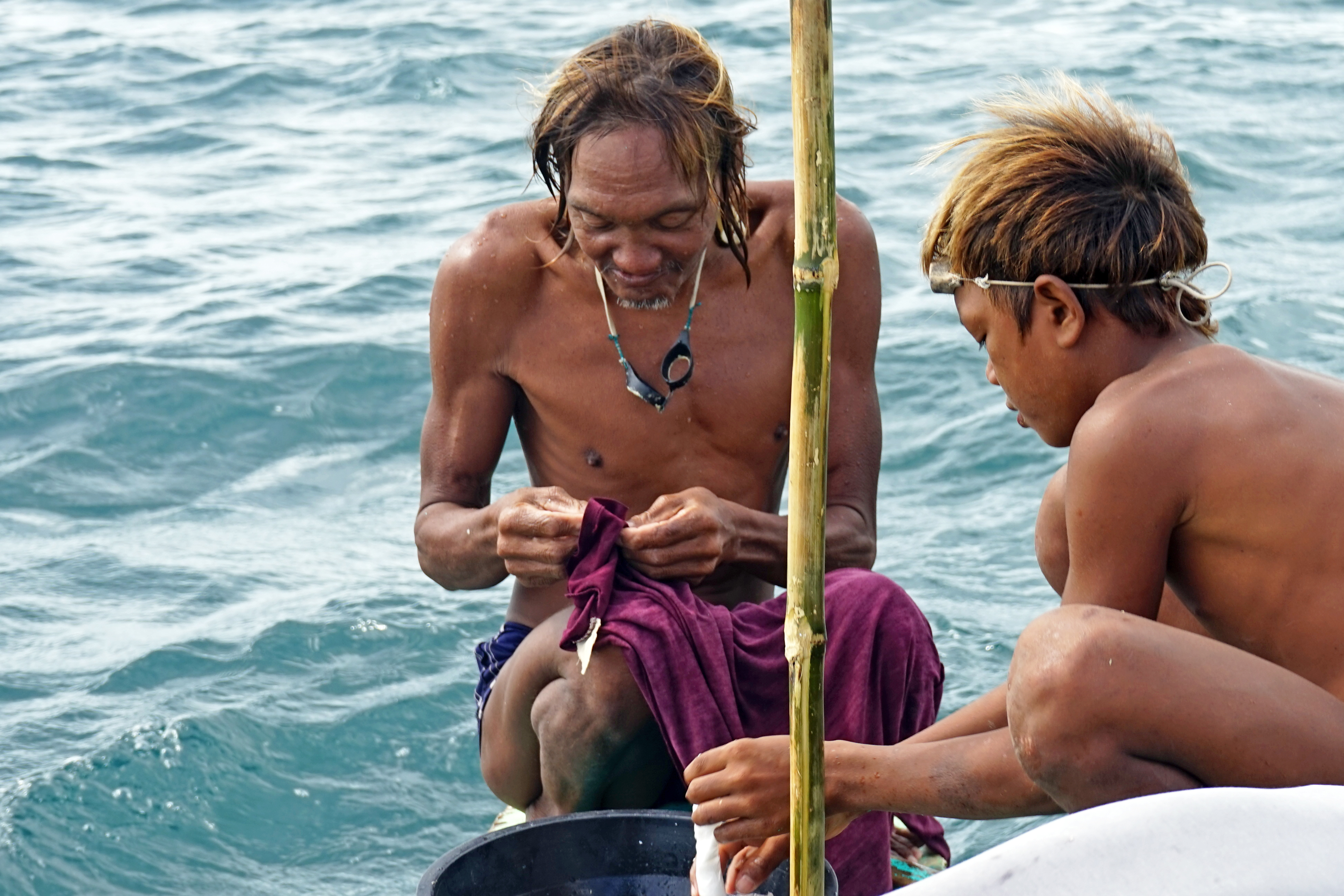
The following two days we followed Noedi spear gun fishing. On the second day Noedi caught a grouper that he kept alive in water, but when we asked him to sell the grouper to some tourists from his boat he refused. “I know many people here, and I will feel embarrassed if I sell it to tourists”, ha said. “I don’t want people to see me doing that”. That was an eye-opener for us. We had seen many men selling fish in the resorts and thought that all Bajau fishermen did so, but Noedi refused. As a matter of fact, Noedi preferred to sell his catch straight to a middleman even if he was likely to get less paid if he did so.
Traditional Healing Ceremony in Bodgaya
On the journey back to Semporna we were accompanied by Noedi and his family, since they wanted to meet their daughter who works in town. While we were looking for the girl, we met a Bajau Laut couple who is related to Noedi’s wife on an anchored houseboat. Quickly, we agreed on following them to Bodgaya the next day along with Noedi’s family who also have relatives there.
In Bodgaya we met up with the couples’ eight children and their in-laws. We also went net fishing nearby Bodgaya with five men on two wooden boats. Two men remained in the boats hitting the water with big sticks while the three others jumped into the water. They surrounded the fish and drove them towards the net. One man also used a speargun for catching larger fish. After some time, the fishermen pulled the nets into the boats. However, the catch was sparse and far from as opulent as some I have witnessed in Sampela where the same method is used. However, the fishing trip was just a showcase and they normally travel far from the community for fishing.
The same evening, we witnessed a traditional healing ceremony performed by a local spiritual leader, a jin, in the village. The daughter of Noedi who had followed us to Bodgaya, suffered from hair loss and was treated by the jin, her uncle. He put the Quran on her stomach and recited holy verses, after which he fell in trance for a few seconds. During these intense seconds he came in contact with the spiritual world and found the reason for her problem: use of veil and the fact that she and her parents had pledged her necklace of gold. The houseboat owner, Kirihati, then made a lively depiction of that Bajau women only use headgear when they collect shell fish under the harsh sun, not in everyday life. After that, the jin gave her a temporary necklace that she would wear until she had retrieved her golden necklace. That night, the girl didn’t use her veil but when we came back to Semporna a few days later she used her scarf again, and the old necklace were nowhere to be seen.
A few days later in Semporna, I met Kirihati and his family once again in the harbor. I noticed that all the children, including Kirihati himself, wore traditional charms that are supposed to protect them against disease and injuries. They invited me to enter the houseboat where I met an elderly man presented to me as Kirihati’s father. While we were talking he took out a pair of nice boots from a shoe box and told me that he was on the way to the mosque for prayer. The whole situation made me puzzled because none in Kirihati’s family had shown any interest of visiting the mosque. However, the old man told me that he had spent many years in the Philippines where he had married his second wife. He was now a practicing Muslim, and he even had a son who was studying in Zamboanga. He was in fact much less traditional than his son.
Boat Living Bajau Laut – are They the Big Economic Players?
After spending some time with Kirihati and his family, I was struck by the great costs of running a big house boat. Under the deck they have a huge diesel engine and beside that they have a smaller gasoline-driven engine used to pump out the water from the boat at night (which also makes a lot of noise). Consequently, some boat living Bajau Laut are the big economical players among the traditional fishermen in Semporna. A large houseboat and a big diesel engine can cost up to 50 000 ringgit, and they will have to pay more for using and maintaining the boat. However, they benefit from being able to move freely and stay longer at sea. Often, they also use smaller, faster boats for long-distance daily fishing trips, which enables them to make even larger catches. Unlike other Bajau Laut they can also sell their catch straight to fish buyers in Semporna instead of relying on middlemen in the islands. They also dry and salt fish which can be kept much longer before being sold.
Hence, if a boat living family keep enough water, cassava, rice, oil and petrol they can stay for weeks on the ocean before returning to Semporna for another round of selling fish for a higher price and buying necessities for a lower price than in the islands. In the longer term, their economic equation simply makes sense.
Police Raid in Kampung Halo and Bangau Bangau
During my last day in Semporna, there was a raid for drug dealers and drug consumers in the communities of Kampung Halo and Bangau Bangau. More than 100 people were arrested and many of them will eventually be deported to Philippines. However, most Bajau Laut I talked to were little concerned by the raids and felt safe. As a matter of fact, the Bajau Laut are less likely to be deported to the Philippines because of their status as stateless. Everyone who is arrested by the migration police will be investigated by the Immigration department, but if you can prove that you are Bajau Laut you will not be deported (unless you have taken drugs, engaged in illegal fishing, etc.). In practice, however, police will seldom bother to scrutinize the Bajau Laut – their boats, their clothes, their dialect and their appearance will be enough for determining their identity.
In this way, the Bajau Laut without identity documents are being kept traditional. This can most clearly be seen in Bangau Bangau which mainly consist of former boat living Bajau Laut from Sitangkai in the Philippines. Here, most of the residents have Malaysian identity cards today and many of them work in town. Some of them do even have their own cars and involve in long-distance fish trading. At the same time there is also a smaller percentage of the community who are not Malaysian citizens and they are much more likely to engage in traditional fishing. Some of them regularly spend days at sea in small “lepa lepa” boats.
The last family we followed in the documentary is a clear example of this. The man, Joy, used to live in a houseboat outside of Maiga during his childhood, but today he is a Malaysian citizen and own his own tourist boat. If he is lucky, he can earn more than 500 ringgit a day bringing mostly Chinese tourists to the islands. At the same time, Joy has relatives in both Bangau Bangau and Maiga who don’t have any legal papers and who face a completely different reality.
After ten days of filming and one week of meeting old friends, I finally left Semporna. The documentary is expected to be released in July in Radio Television Hong Kong (RTHK) and on Youtube. I will share the link with you.
Exploring the Diving Skills, Livelihood and Cosmology of Bajau Laut
From mid-August to mid-September, I made a new trip to Southeast Asia. I visited several Bajau Laut communities in Indonesia, Malaysia and Philippines.
Spleen Size Among Bajau Laut in Indonesia
In the beginning of the journey, Professor Erika Schagatay and I re-visited the villages Topa and Sampela outside the coast of southeast Sulawesi. Here, we continued to collect data on lung capacity, spleen size and other physiological characteristics of importance to a livelihood based on diving. During parts of the trip we were also joined by freelance journalist Sushma Subramanian who was making a story about our work in the field.
We followed on several fishing trips, including speargun fishing and shallow water harvesting. In Sampela, many women collect shellfish, and they display great skills. They have an impressive knowledge about the sea life and can find sea shells well hidden under the sand. Many men are still making a living from speargun fishing even though fish size is reducing. However, on the last fishing trip one of the fishermen caught a large barracuda with help from his fellow fishermen.


In April this year, we were reached by the news that not only Bajau divers, but also non-diving Bajau in central Sulawesi have naturally larger spleens than people in general. A Danish-American research group have found evidence for natural selection on the gene PDE10A which regulates spleen size, as well as for the gene BDKRB2 which is linked with the so-called diving response. The data was compared to a neighbouring sedentary group, the Saluan, which on average had much smaller spleens. The study was published in the article Physiological and Genetic Adaptations to Diving in Sea Nomads in Cell, and gave clear evidence for recent evolution for diving in the Bajau.
After the article was published, questions regarding the findings in relation to the waterside theory have been raised: does the findings support or contradict the theory of an aquatic past in human evolution? If spleen size has grown recently in Bajau, and if we hypothesise that our distant forefathers were also diving, shouldn’t our forefathers have the same mutations on these genes? One explanation can be that genes coding for spleen size and certain diving reflex functions can change quickly over time and that specific genes have changed from pro-diving positions after humanity as a whole abandoned a semi-aquatic lifestyle, and then became more prominent again in the Bajau. This idea should be possible to falsify by looking at approximately 60 000-year-old DNA samples when nearly all humans still lived in the tropical zone. However, if we look at the evolutionary bigger picture the new findings do not contradict a past semi-aquatic lifestyle in humans. We have to take into consideration that humans overall have much larger spleens that for example chimpanzees and gorillas. Hence, even if Bajau have undergone a recent evolution in spleen size, it doesn’t mean that humanity doesn’t have a prerequisite for large spleens. Also, Erika’s and mine temporary data on spleen size among Bajau clearly shows that trained Bajau divers have much larger spleens than no Bajau divers. Hence, it is still obvious that regular diving is of great importance for spleen size.
Further research on spleen size and larger genetic analysis should be carried out before relevant conclusions can be made. For example, it would be interesting to see if other Bajau groups in other parts of Indonesia have the same genetical adaptations to diving, not least since one study, The last sea nomads of the Indonesian archipelago: genomic origins and dispersal, showed that Bajau groups in Indonesia are often more closely related to neighbouring people than to other distant Bajau groups, since inter-marriages have been very common throughout the history among Indonesian Bajau. One study should also look at skilful female Bajau divers, since some Bajau women still are great divers, as for example in the village of Kabalutan in Togian, Sulawesi. It would also be interesting to take a close look at Bajau groups from for example Philippines and Malaysia, and perhaps especially those from northern Sulu and from islands and places such as Siasi, Basilan and Zamboanga. The great free diver Sulbin that walks on the seabed in a BBC:s series Human Planet was born in the island of Siasi in the Philippines.
Search for the Last Sea Nomads in Lasolo and Sombori
In Indonesia, it is still common that Bajau fishermen make longer fishing trips where they stay in their house boats for a couple of days or weeks. However, it is unclear if full time nomadic Bajau groups still exist in Indonesia. I was told by a Swiss traveller that she had encountered Bajau houseboats only two years ago in Sombori, just north of Lasolo in southeast Sulawesi which was one of the last strongholds for nomadic Bajau people.
After my trip to Sampela, I decided to explore Somobri and Lasolo more closely to see if there are any nomadic Bajau left – or at least to get the chance to talk to Bajau people who only recently left their houseboats. I went to Saponda near Kendari and from there I followed four young Bajau men on a three-day trip to Lasolo and Sombori. First, we reached Labengki kecil where we visited a small Sama community but with no recent boat dwellers. The same day we reached the community Dongkala in Sombori, where we settled in the house of the Kepala Desa, the local chief. We walked to the outskirts of the village where there were some recently built houses, and one elderly woman told me that she had left her houseboat approximately only five years ago. However, she told me that there were no nomadic Bajau left in the region. Next day, we took a small trip around Sombori before we headed towards Lasolo, where we visited three traditional villages of former nomadic Bajau people: Pulau Meong, Toroh Gusoh and Marombo. However, they told me that there were no boat living people left and that many of the older “Bajau Soppe” had passed away. In Marombo, I met a healthy elderly man and I asked him if he still knew how to construct the traditional houseboats, and he told me that he and his brother in Toroh Gusoh still knew how to build them. However, it seems as that are no longer any nomadic Bajau left in this part of Sulawesi.
Pre-study for Documentary Movie
After my trip to Indonesia, I headed to Semporna, Malaysia, where I met a documentary director from Hongkong who will make a documentary on the Bajau. During some intense days we visited the islands Bodgaya, Maiga, Denawan, Omadal and Mabul where we interviewed nomadic and sedentary Bajau Laut. We asked questions such as: do you prefer to live in a houseboat over a house? Do you want your children to go to school? Do you have national identity card? Do you recognize yourself as Malay? The documentary will focus on statelessness and how it affects them, and their day-to-day life.
In the interviews, it was clear that most people in houseboats prefer to stay in the houseboat arguing that It is much easier to make a living from the boat than from the house. As a matter of fact, those who live in houseboats are often better off than those living in stilt houses. A houseboat is also much more expensive than a house. Many boat dwellers told us that they get land sick if they stay in a house; they are used of the never-ending flow of water under beneath them. They also told us that they are not interested in sending their kids to school, partly because they think that their children would get land sick but also because of that education is not for them. They rather learn from the sea than from the class room. Even many house-dwelling Bajau Laut said that they would prefer to live in a house boat if they could afford it, while others said that they now prefer to live in houses because they have become used to it. When we asked about their background, more or less all houseboat-dwelling Bajau Laut answered that they originally came from Tawi-Tawi. Many said that their forefathers came from the communities of Sanga Sanga and Tungbankao. However, in my last days in Semporna I also came across fully nomadic Bajau Laut just outside the community of Bangau Bangau who trace their roots to Sitangkai in southwestern Philippines. They were staying in smaller lepa lepa boats, while many Sama Dilaut Tawi-Tawi today live in bigger houseboats. They told me about their animistic rituals and beliefs, and that they once a year use to travel to Sitangkai on their houseboat to participate in the annual magpai baha’u ritual in which spiritual leaders (jinns) dance in trance to connect with the spirits.
The community of Bangau Bangau which is largely made up by Bajau Laut from Sitangkai is very diverse. Here, some of the residents have their own cars and work in the town, while others still make week long fishing trips on traditional boats. A majority of its residents have national identity cards, unlike the Bajau Laut from Tawi-Tawi. Almost no houseboat dwelling Bajau Laut consider themselves as Muslims. However, a majority of the Bajau Laut in Bangau Bangau consider themselves Muslims even though they still hold on to many traditional beliefs. For them the “Sama religion” is a syncretism of animism and Islam, but for most Bajau Laut from Tawi-Tawi it is simply “Sama”.
In total, there are more than 100 houseboats in the waters of Semporna. On Maiga, I could also see some new, big houseboats being built. Probably, the nomadic lifestyle will not come to an end in the coming years. Declining fish populations is of course a great threat to the livelihood of Bajau Laut as a whole, but those living in houseboats are more likely to be better off than those living in houses.
Recent Migration of Sama Dilaut from Philippines to Malaysia
In recent years, many Sama Dilaut whose forefathers remained in Tawi-Tawi and other Philippine islands during the turmoil in the 70’s and 80’s have started to migrate to Semporna because of the growing economy in the area. It is foremost the increase of Chinese tourists that attracts the increasing work force. The difference between Sama Dilaut Tawi-Tawi who remained in Philippines and those who arrived in Semporna in the last century is striking. In Philippines, the nomadic lifestyle has since long been abandoned and schooling have been common. Today, they have a different world view than their relatives in Semporna. I was told that many newcomers buy live fish from more traditional Sama Dilaut fishermen and sell it to Chinese tourists. For them a life on the houseboat is far-fetched and they are more open to education.
As a matter of fact, the policy of the Malaysian government towards the Bajau Laut makes them traditional. No health care, no education, good security at sea and fear of deportation at land – all these factors contribute to keep them, or even make them more, “traditional”. Ethnicity is about expectations and negotiations; it is basically a result of the inter-relations between different people and the state. As a result, second cousins who grew up in Tawi-Tawi and Semporna might today have a different view on the Sama identity.
In Indonesia, the approach from the state has been different. The Indonesian authorities have actively engaged in creating Bajau communities and integrated them in the larger political structure. Here, many Bajau Laut are proud Indonesians, and they are more integrated and less prejudiced than their Malaysian and Philippine relatives. In Sampela, which probably is one of the most traditional Sama communities in Indonesia, one man and his wife recently made Hajj.
Traditional Goggles Still Preferred Among Skillful Divers
In the end of the trip, I re-visited the Bajau Laut community in Matina Aplaya, Davao, Philippines, where I first came in touch with the Sama. I spent a week in the community along with a Danish freelance photographer and free diver. The Bajau Laut in Davao belongs to a third group of traditionally boat living Sama people, the group from northern Sulu (Zamboanga, Basilan, Siasi and Jolo). Probably none of them are residing in houseboats today, but they are known to be great divers. This group is also the one mostly seen begging below ferries and in major Philippine cities such as Manila and Cebu. They have been displaced throughout the Philippines and also Sabah because of conflicts and a drastic decline in marine life in Sulu.
In Davao, I followed some traditional fishermen speargun fishing in the gulf of Davao. Here, the most active divers still prefer to use the traditional goggles. I have made the same observation in Sampela: the most skilled and active divers are likely to keep the traditional goggles, even though they can afford a mask. They say that they are used of wearing the small goggles and that they feel uncomfortable with a big mask. The reason can be that they don’t need to use energy to equalize the mask. Another reason can be that the so-called diving response is more easily activated when smaller goggles are used.
In Davao, I also visited a big Bajau Laut community in Isla Verde where many traidional Bajau Laut animists reside. However, only few Bajau in Davao do still rely mostly on fishing for making a living. Shoe vending and pearl vending are the most common professions in the area today.
In mid-September, after more than 40 days of travelling, I returned home to Sweden.
New Movie: Bajau Laut – Underwater Hunter-Gatherers
Recently, I released a new movie about the Bajau Laut. The short movie focuses on hunting and gathering below the water surface and was recorded in Philippines, Malaysia and Indonesia during my previous field trips. The Bajau Laut (or Sama Dilaut) are one of the most wide-spread indigenous peoples of Southeast Asia and have been living on the sea for more than 1 000 years.
Michel Odent: “Domination of Nature is Related to the Way we are Born”
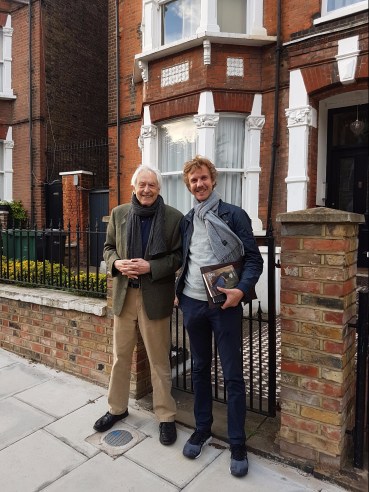
During a visit in London in early October I was fortunate to meet 87-year-old French obstetrician Michel Odent. He is the pioneer of introducing birthing pools and he is an active promoter of the limit of use of medication during labor and delivery, as for example oxytocin, nitrous oxide and drugs.
State of Reduced Neo-Cortical Activity While Giving Birth
Michel Odent has also introduced the concept of fetus ejection reflex in humans, meaning that women in labor can give birth instantly in moments of reduced rationality. It may occur during a sudden movement, in an instant loss of rationality, by surprise; on the kitchen floor or in the taxi on the way to the hospital. The term was first coined by Niles Newton who studied the birth process of mice, and was later transferred to the context of human birth in order to explain some of the birth’s Odent attended as a practitioner. It’s a reflex present in all mammals.
The reduction of neo-cortical activity is also present before birth. “It is common that pregnant women start to forget where they have put their keys”, Odent explained, “and this is a physiological preparation for giving birth”.
The “Fetus Ejection Reflex” is not Culturally Accepted
Odent explains that the state in which fetus ejection reflex is made possible is not culturally accepted, and for that reason carefully avoided in modern medicine. Odent depicts a state in which all civility loses its presence, in which the woman in labor can start to insult her surrounding, scream nonsense and make awkward movements, but this state is also a state of easing the birth process. Few women will remember what actually happened, but they will also forget the pain of delivery itself.
Experts on breast feeding have found that young women who have delivered their babies with a genuine fetus ejection reflex – still in a state of reduced neo-cortical activity – have been picking up their babies according to the right movements, sprawled their fingers perfectly, giving the babies their breasts – without any initial learning. Hence, the state of reduced rationality is also present the hours following birth, and it seems to correlate with an instinctive birth process. “Also then the woman should be kept in solitude”, according to Odent.
The Knitting Midwife
One of the prerequisites for a genuine fetus ejection reflex is that the woman who is giving birth should be alone and not rationally appealed. Odent has introduced the concept of a knitting midwife: a woman with own experience of birth that sits in in the corner of the room deeply engaged in a monotonous activity, as for example knitting; hence, not transmitting anxiety, nor appealing to the rational mind of the woman in labour. This is far from the today’s reality in which chemicals and a constant communication by words like “drink some more water” are widely used.
Odent has also become known for his statement that the father should not be present at the time of birth, because the father often transmit anxiety.
Birth in Pre-Agricultural Societies
According to Michel Odent most pre-agricultural societies gave birth in solitude. Odent give example of some traditional people living today as for example Kung! in southern Africa and the Piraha in the Amazon (the Piraha are also known for giving birth in water in a nearby river).
The fetus ejection reflex has also by accident being filmed by the medical anthropologist Wulf Schiefenhovel in 1978 who made video recordings of the Eipos in New Guinea. In one sequence a young woman can be seen giving birth with a genuine fetus ejection reflex among the bushes, completely unaware of the camera. “This would be completely impossible in today’s medicine”, Odent said.
The way we are Born Determines Whole Societies
For Michel Odent, the birth itself is part of a bigger picture; the domination of nature itself. When we started to domesticate plants we not only started to control nature, but also the human nature. In the process of domination of earth, we transformed ourselves into a “domesticated animal”. By interfering in the human birth process we have also changed the nature of humanity.
For example, the maternal protective-aggressive instinct is universal among mammals, but in numerous human societies around the globe this is ruptured by separation from child and mother at an early stage. Ideas that the first milk made up by cholesterol is poisonous and that a woman’s nipples should be wiped with alcohol in order to avoid spread of diseases from mother to infant, are also example of cultural intervention in the birth process. According to Odent, this can help to explain the foundation of aggression in humans and domination of nature. “In order to be able to dominate nature and neighboring people, it was important to increase the level of aggression”, Odent explained.
Caesarean Section Dramatically Changes the Birth Process
Today, the rate of caesarean section is larger than 50 % in countries as Turkey and parts of China. Despite the fact that the mortality rate in caesarean is lower both for mother and child compared to vaginal birth, Odent is worried about its implications. For example, the microbes that will be transmitted through the vaginal canal to the baby at birth is crucial for the immune system. A natural birth also releases a cocktail of hormones as for example oxytocin that is developing a strong bond between mother and child. In an experiment, a gorilla delivered with caesarean section, but she didn’t bond with her baby at all after birth. More than that, a child being born with the use of caesarean section will not have any melatonin in its blood, which is an important stress release hormone.
According to Odent, there is also a correlation between how a mother was born and how her own kids will be born. There might be a possibility that epigenetics – the process in which genes can be activated and deactivated depending on the lifestyle of previous generations – also play a role in the way women give birth. If that is the case, we might be unable to give birth in the natural way (just like the bulldog, of whom over 80% of are delivered by Caesarean section today), in a few generations to come.
An Author of Numerous Book – a New Book Released just a few Weeks ago
Odent is author of books such as “Do we Need Midwives?” and “Childbirth and the future of Homo Sapiens”. For a few weeks ago, he also published the book “The Birth of Homo, the Marine Chimpanzee: When the Tool Becomes the Master”.
Odent is also regularly invited to conferences and seminars around the world, and for only a few weeks ago he was invited to Turkey by Mr’s Erdogan herself. “There is a worry about how women give birth in Turkey”, Odent said. “It’s good that people get more knowledge about the birth process and the risks that is associated with modern birth practices”.
“Ultimately this is about the domination of nature – and we have reached the limit already”, Odent concluded. But the birth process may also contain the keys to a less harmful approach to nature. Perhaps, the way we are born can change our urge do dominate and control other people – and Mother earth herself.
Meeting with AAH Proponent Marc Verhaegen in Belgium
During a visit in Belgium, I met Dr Marc Verhaegen in Putte near Mechelen. Marc Verhaegen is a leading theorist of the Aquatic Ape Hypothesis and is probably along Elaine Morgan the one who has published most about the AAH.
When we met at the train station in Mechelen, Marc told me that Elaine Morgan and Dr. Erika Schagatay once had visited him in Putte after a conference about the Aquatic Ape Hypothesis in Gent in 1999, and that they had visited the nearby zoo at Planckendael with a small population of Bonobos.
“When Elaine Morgan came here, she stepped right up to the bonobos, ignoring the other animals”, Marc Verhaegen told me during our visit in the zoo. “Then she watched them for half an hour, and we left the zoo.”
After the visit at the zoo, we drove to Verhaegen’s house in Putte. “I became interested in the theory when I read Morgan’s books about the AAH in the 70s and 80s, beginning with her first book in 1972”, Verhaegen explained. Since then, Verhaegen has spent a lot of time researching on the theory, and he keeps updated on new research in palaeoanthropology, physiology, biology and other fields. He is also the founder and editor of the well-known Yahoo group “Coastal Dispersal of Pleistocene archaic Homo (the so-called Aquatic Ape Theory)” with more than 600 members. He has also participated in all the larger conferences on the AAH over the years, as well as the latest one in London in 2013 – which I also attended.
Verhaegen has Turned Away from the Paradigm Once Formulated by Hardy and Morgan
However, Marc Verhaegen has since long abandoned the old paradigm formulated by Alister Hardy and Elaine Morgan, according to which the aquatic phase in our evolution took place right after the split from the chimpanzee, for perhaps 7 million years ago, which was followed by a terrestrial phase. According to Marc Verhaegen, the waterside hypothesis is less about the split from the chimpanzees than about what happened with human ancestors belonging to the genus Homo for approximately the last two million years. “Homo erectus was clearly more adapted to a littoral lifestyle than its earlier forefathers”, Verhaegen said. “Their big very heavy (dense and thick) skeleton and broad pelvis indicate that they were shallow water divers, harvesting shellfish and probably seaweeds and other littoral foods.” Similar aquatic adaptations can be seen in Homo heidelbergensis and Neanderthals, still more than in Homo sapiens. “But it is likely that Homo sapiens became more used of wading in very shallow waters and walking along the waterside, and that they dived less frequently”, Verhaegen said. “This shift can have been due to an ability to extract resources in more shallow water, probably thanks to new technology, such as dugouts, reed boats, spears or nets.”
According to Verhaegen, other great ape ancestors have been living close to a water environment in the past. “We also must remember that the chimpanzee has evolved after they split from us”, Verhaegen said. “Over the last five million years they have become less acquainted to water, but at the time of the split we were most likely living in swamp or flooded or coastal forests”. Hence, the transformation to an aquatic phase was not a huge evolutionary step. “An upright body posture probably appeared because of stepping down vertically from the trees to the water.”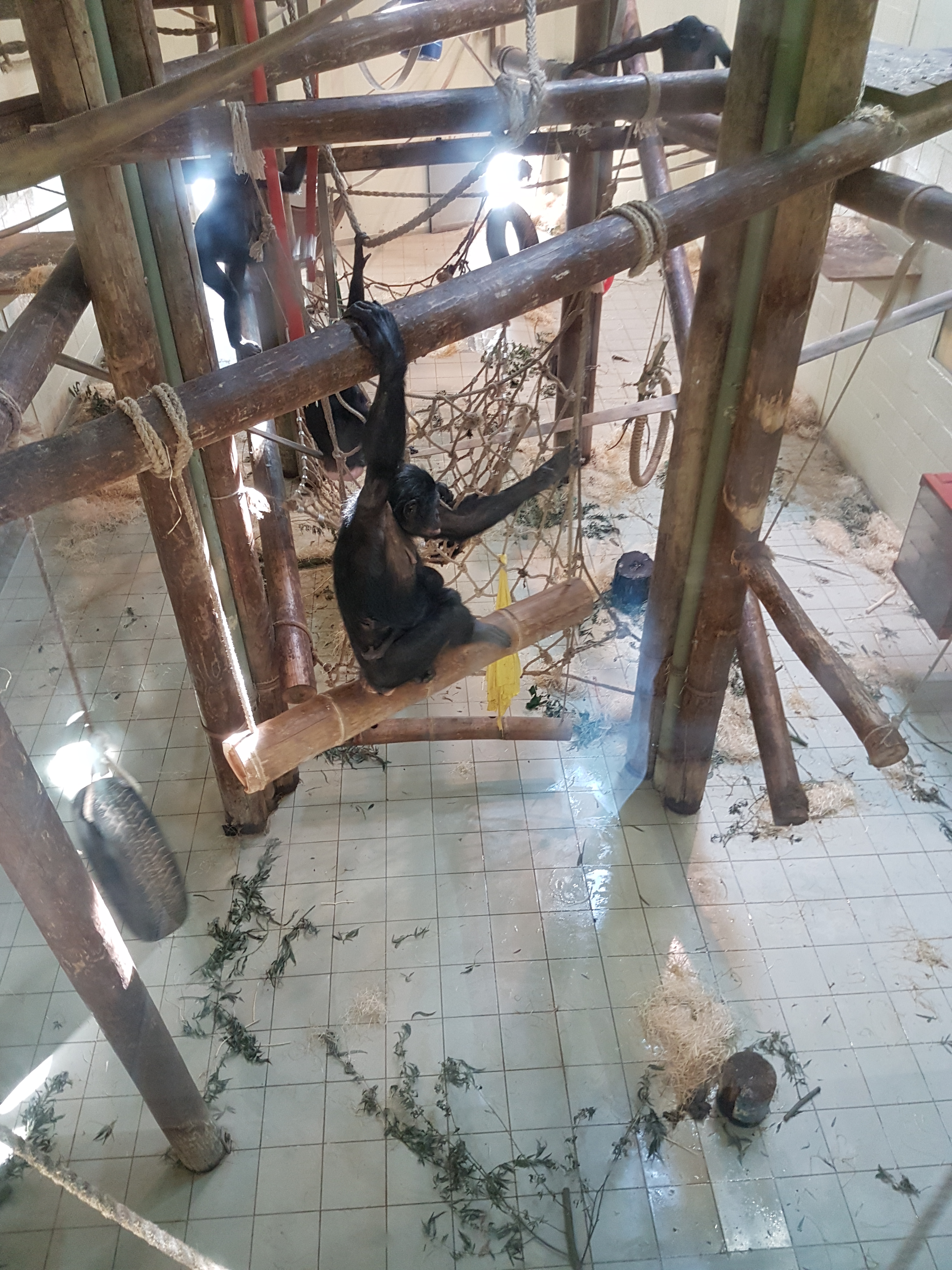
“The AAH is Primarily a Biological Theory”
Verhaegen emphasizes that the Aquatic Ape Hypothesis primarily is a biological theory, and not an archaeological theory. “Our bodies hold the key to our evolutionary background,” Verhaegen said. “That give us much better evidence than the fossils.” As a doctor, Verhaegen has a great anatomical and biological understanding of the human body, and from this perspective it is not strange that many doctors have been supporting the Aquatic Ape Hypothesis throughout the years. On the top of that, Verhaegen is also a great theorist and he is breaking new grounds in the development of the AAH. Unfortunately, many of Verhaegen’s theories are challenged, not only by critics of the AAH, but also of its proponents who insist on a “lighter” version of the theory. For example, the idea that Homo erectus or close relatives thereof were shallow-water divers, and that frequent wading and walking came later during the Pleistocene in our evolution, is still hard to accept for some proponents, even though significant archaeological and other data point in this direction. Verhaegen argues that several littoral adaptations only appeared in Homo erectus, not only a very heavy skeleton, but for instance also a low long flat skull, drastic brain expansion (arguably due to consumption of abundant brain-specific nutrients in shellfish etc.), an external nose, ear exostoses due to exposure to cold water, dorso-ventrally flattened thigh-bones (femora), intercontinental dispersal (including colonization of islands such as Flores, Sulawesi, Crete), traces of shellfish consumption and human-made engravings on shells, etc.
Wide Acceptance of Aquatic Life of Homo sapiens – but not of our Forebears
Today, the wider scientific community accept the fact that early Homo sapiens was often living close to seashore. The findings of 125,000-year-old tools in a former coral reef in Eritrea was published in Nature and reached the front page, and recent older findings, for instance, in the Pinnacle Point in South Africa has also got similar attention – and approval. However, most traditional paleoanthropologists will not admit that these people had evolved in an aquatic environment. They choose to see these adaptations as a colonization of one of many environments humans were living in, rather than an early evolutionary adaptation to an aquatic environment.
But why stop with Homo sapiens? Why doesn’t the community also accept aquatic adaptations in for example Homo erectus and other archaic-looking Homo species as for example Neanderthals that perhaps show the clearest signs of an aquatic adaptation? Why is it so difficult to accept these findings? Why do we only accept signs of an aquatic lifestyle after Homo sapiens had already emerged?
The visit in Putte was very pleasant and hospitable. We stayed up till late night in Verhaegen’s office, where he showed me books and publications of earlier conferences, as well as his own drawings of the possible features of Homo erectus. “I hope that the Aquatic Ape Hypothesis will get widely accepted before I pass away,” Verhaegen said. “I have been waiting for a shift for many years, but until now I haven’t seen any greater improvement. As a matter of fact, I am still amazed that the paleoanthropological community doesn’t accept the theory.”
The Waterside Hypothesis Requires a Rethinking of Human Evolution
In a 2016 September BBC radio program titled “The Waterside Ape”, Sir David Attenbourough presents new evidence for the waterside theory that have been published in recent years. In the program, they interview free diver Sara Campell who went from a total beginner to a holder of three world records in just eight months, Erika Schagatay who have studied Japanese Ama divers and Bajau divers and compared the data with semi-aquatic mammals and Curtis W. Marean who has discovered dependence on mussels and sea-snails among Homo Sapiens at Pinnacle Point in South Africa at 164 k years ago.
Surfer’s Ear Hard Evidence for the Waterside Hypothesis
A particularly interesting evidence has been formulated by P.H Rhys-Evans and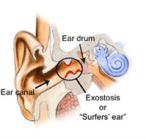 M. Cameron in their article “Surfer’s Ear (Aural Exostoses) Provides Hard Evidence of Man’s Aquatic Past” in 2014 in which they show that aural exostoses have been found not only in old Homo Sapiens fossils but also in Homo Erectus and Homo Neanderthalensis fossils. Surfer’s ear is a bone growth in the ear canal that protects the eardrum from pressure, which is proportional to the time spent in cold water. The bone growth has been found in fossils stretching as far away as South Africa, the Mediterranean and Australia. According to Rhys-Evans this bone growth can only be explained by extensive swimming in cold water.
Critical Response in The Conversation
After the program was released, critics Alice Roberts (Professor of Public Engagement in Science, University of Birmingham) and Mark Maslin (Professor of Paleoclimatology, UCL) wrote a reply in The Conversation with the title “Sorry David Attenborough, we didn’t evolve from ‘aquatic apes’ – here’s why”. In the article, they claim that many of the adaptations that are suitable for an aquatic environment, as for example hairlessness and increased body fat can be explained by a need of cooling down and sexual selection. They also claim that many of our aquatic adaptations evolved on different occasions throughout human evolution, why water cannot be the explanation. Bipedalism, for example, emerged about 6-7 million years ago while our brain started to enlarge about 2 million years ago. They also highlight the flexibility of human behaviour, and they explain later water adaptations as for example the one mentioned in the Pinnacle Point starting at 164 000 years ago, as behavioural adaptability rather than as an inherited way of life.
But why rely on sexual selection? What is attractive in generally what is viable in terms of survival. Hence, if humans started to like hairless bodies and more fatty breasts, it was rather because these characteristics were evolutionary useful, not only that they were considered beautiful. And is it really a problem that different characteristics have evolved on different occasions? The increase of brain size in Homo Erectus is probably much linked to the emergence of deep water Rift lakes that enabled increased feeding from aquatic resources. Hence, the aquatic phase in human evolution was not something that just took place many millions ago right after we left the trees, it has been influencing our evolution till the very emergence of Homo Sapiens.
Misleading and Deep-rooted Criticism against “Pseudo-science” and lack of Fossil Evidence
Bluntly, Roberts and Maslin also criticise the theory for being “pseudo-science” as is does not make any falsifiable predictions, of course irritating many of the researchers outside the area of palaeoanthropology who respectively have found strong evidence for an aquatic past in the fields of for example human physiology, obstetrics and otorhinolaryngology. In a falsifiable experiment, it has also been shown that vernix caseosa, the white substance found coating the skin of new-born human babies is likely to be an adaptation to entering water soon after being born. Further, obviously without listening carefully to the BBC program, Roberts and Maslin also claim that there is no fossil evidence to support the waterside hypothesis even after the discovery of surfer’s ear in Homo Erectus, as well as predation and preparation of very large catfish in Turkana basin at two million years ago, and the fact that literally all well-known fossils as Lucy and Selam have been found in river sediments. Lucy was found next to fossilised crocodile and turtle eggs.
Some of the researchers who participated in the program responded to the criticism from Roberts and Maslin here: A reply to Alice Roberts and Mark Maslin: Our ancestors may indeed have evolved at the shoreline – and here is why…
The Scientific Evolutionary Story of Man is Closely Related to our Belief in Development and Constant Growth
It is sad that the Aquatic Ape/Waterside theory since long has been misunderstood and rejected without further thought. This is also being reflected in other books and magazines dealing with human evolution. Mostly, the savannah or mosaic theory are taken for granted, and forms a basis for further reasoning. This is also the case with the great selling author Yuval Noah Harari, who has written the books Homo Sapiens and Homo Deus. When he talks about our evolutionary past he always relates to the savannah, even though there no longer is any savanna theory out there. Hence, many scholars adapt to the paradigm set by the paleoanthropologists, but which is false. We also have to keep in mind that the concept of human evolution is closely connected to our belief in development and growth. The generally accepted evolutionary story of Homo Sapiens is in fact the scientific creation myth of man, and it repeatedly depicts a human ancestor who were living in a diverse mosaic environment always eager to adapt to new circumstances using an emerging intellect and creativity, and not it’s bodily functions. There is thus a red thread between myth of human evolution and today’s pursuit of constant growth.
The Waterside Theory Requires Another Story of Human Evolution
But the aquatic ape theory tells us another story: here most human characteristics can be explained in relation to a specific biotope: the waterside. However, this idea can’t be accepted by the paleo anthropologists because It implies another creation myth that does not go hand in hand with the idea of development. Hence, by strengthening the waterside theory, the proponents of the theory just make it more inappropriate in the anthropological community. That’s why they compare the theory with the mythological hydra: if you cut off one head, two new ones grow out.
The only solution to this dilemma is to accept the fact that humans during evolution were nothing special. We were not the masterpiece of creation. We were just one animal among others. We ate shellfish that we collected in low tide or by diving. We were walking, wading and swimming long distances along the shore lines. We gave birth to the children in water. And, most importantly, we were not creative engineers, who always came up with new ideas for survival. There was no need for constant invention – because their world was never changing as rapidly it does today. What was important to our ancestors was to learn the techniques of survival that were already in use. What was important to our ancestors was to learn the techniques that were already in use, ranging from tool manufacturing, motor skills and resource utilization. They also inherited a profound knowledge about edible plants and marine resources. As a matter of fact, if we look at the tools used by our human forefathers we can see that they were made in nearly identical ways over long periods of time. The stability and the cons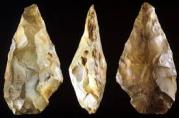 ervatism in the tool making traditions as for example Oldowan stretching from 2.6 million years BP to 1.7 million years BP, Acheulean stretching from 1.76 million years BP to 100 thousand years BP and Middle Stone Age (MSA) starting around 280,000 years ago and ended around 50–25,000 years ago have been extremely conservative over hundreds of thousands of years. Where were all the innovations? And why did the early group of Homo Sapiens that made it all the way to Israel around 130 – 85 thousand years ago not out conquer the Neandertals? Why were the same caves inhabited alternately by both Homo Sapiens and Neanderthals before Homo Sapiens finally disappeared from the area?
In fact, what distinguished man throughout history was rather an extremely precise handwork, a strict repetition of long series of complex hand movements; or in other words: a repetition of already acquired technology. And not a constant flow of inventions and change.
A New Paradigm Which is not Based on the Idea of Development is Required
We must accept a new paradigm – that humans were not ingenious creators but rather extremely skilled imitators – and I am convinced that this paradigm will grow in popularity when we fully realise the destructive impact humanity and rationality have on this earth. Soon, the believe in development will not lay the foundation of the scientific creation story of man.
But then, what happened? Why did Homo Sapiens finally change and start to migrate to the most diverse environments? Yuval Noah Harari talks about a cognitive revolution that took place approximately 70 000 years ago enabling us to organize people on a larger scale in relation to a common shared world view. The revolution also led us to manufacture more advanced tools, create more diverse art and hunt on a large scale. Yuval Noah Harari argues that changes in our DNA enabled this change. Again, we can see the strong faith in the connection with human evolution and today’s growth, and the conviction that today’s humans reflects the inner core of our DNA. In other words, the paradigm assumes that we are meant to be geniuses.
But can small changes in brain make that difference? And if so, what was the purpose of our large brains that we had as early as 200 000 years ago despite not creating any visible inventions?
We Must Rethink our Brain and Language
There is, as I see it, only one possible answer to this dilemma. The creative capacity of man throughout most of our evolution was latent. It was a part of our brain and  potential, but not utilized. It evolved, but as the other side of the coin. The main function of the growing brain was rather to repeat earlier invented behaviour, not to start the day by coming up with an ingenious idea about luring a big prey. We also must keep in mind that tool management and language are located in the same part of the brain and closely related to each other. Hence, the function of this part of the brain was to cement behaviour and movements, to master the art of reappearance. But when the humans had to leave their tropical environment because of climate change – as in South Africa approximately 100 000 years ago – this language lost its grip and turned creative. In other words, maybe the brain in its essence is anti-development. That, I am sure, will be the paradigm of tomorrow.
Video: Bajo Man Bites an Octopus Between it’s Eyes
I recorded the following video during my trip to Kabalutan, Togian, Indonesia, in February this year. The octopus was caught with a speargun and lured with a fake octopus.
Bajo in Kabalutan still stick to their traditional fishing methods while the waters around them are being depleted by big commercial fishing vessels.
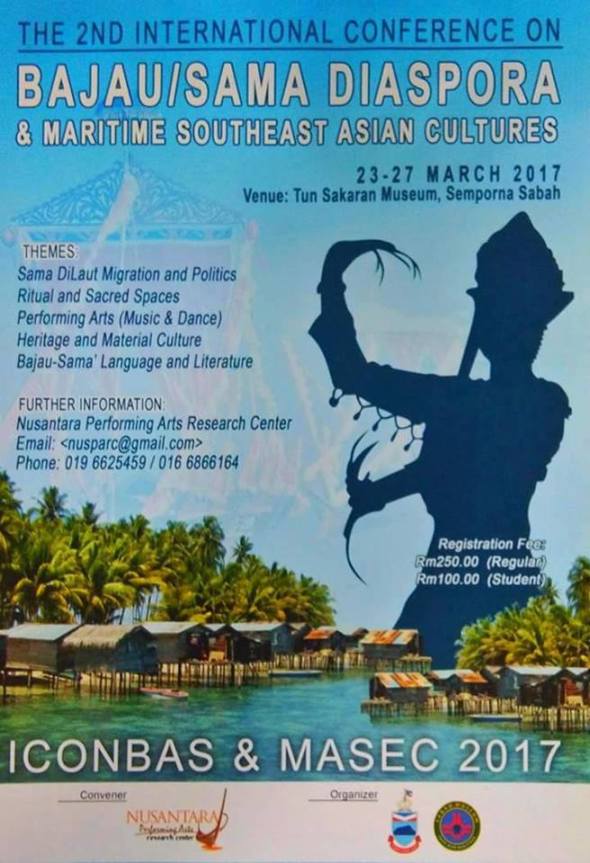
Attending the 2nd International conference on Bajau/Sama’ in Semporna
Between March 23-26 I attended the 2nd International conference on Bajau/Sama’ Diaspora and maritime Southeast Asian cultures in Semporna. It was an interesting conference with skilled scholars who presented papers about long epic songs among Indonesian Bajo (iko-iko), more than 3 000 years old archaeological sites in Semporna and much more.
Presentation on Sama Dilaut Challenges
During the conference, I made a presentation about the contemporary challenges facing Sama Dilaut in both Philippines, Indonesia and Malaysia and discussed possible solutions to the crisis. Sama Dilaut are facing a variety of problems, as for example indebtedness, reduced fish stocks, lack of ID:s and market distortion, and there is no easy fix. You can see my Power Point-presentation from the conference here: Sama Dilaut as Guardians of the Sea. My conference paper will be published later.
Another problem that are facing Sama Dilaut in Sabah are new regulations on use of engines. Many of the smaller engines used to be put inside the boat are now illegal and as a consequence many more Sama people are now using sails than before. The new regulaitons have been in place for little more than a year and has made search for livelihood increasingly difficult for many Sama Dilaut. 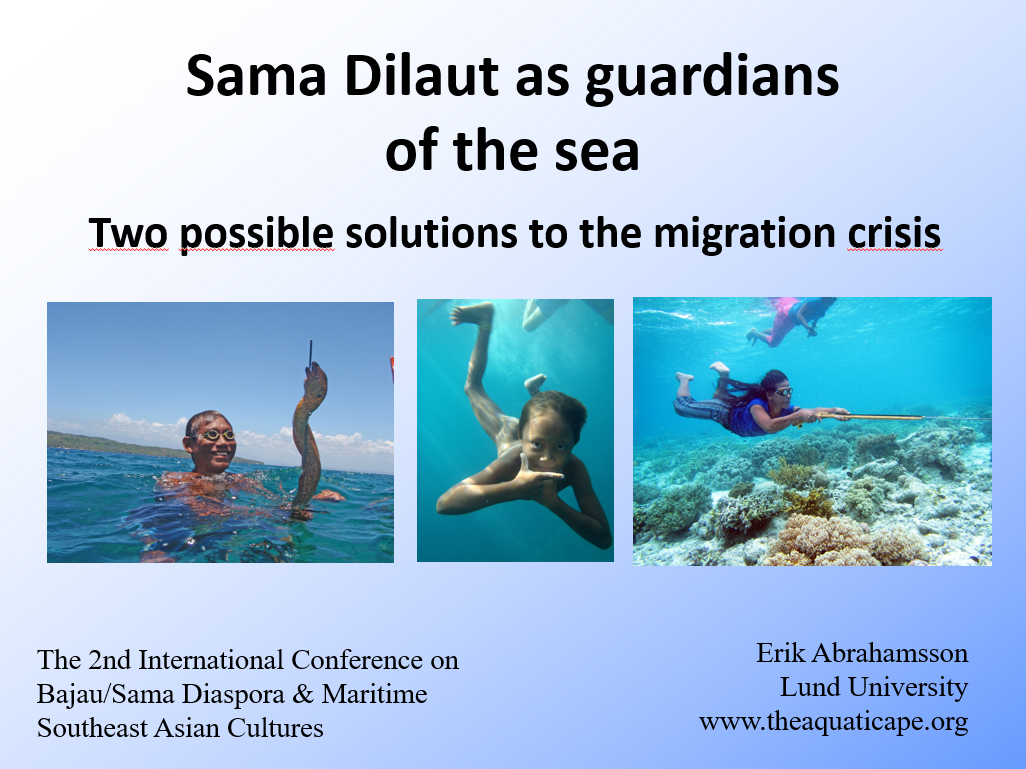
In the conference, archaeologist Dr. Stephen Chia presented findings of old pottery stoves on the archaeological site Bukit Tengkorak that is more than 3 000 years old and has more or less the same appearance as present day pottery stoves made by Sama people. This might mean that Sama people have been living in the area for millennia, or perhaps they did learn the handicraft technique of people who were already living there.
Few Sama Dilaut Attended the Conference
The conference in Semporna was truly international, with Sama people from both from Malaysia, Philippines and Indonesia attending the conference. It was great to see this mixture of culture and language and that the bonds between the Sama groups in the different countries gets stronger. I also came to realize that Central Sinama (widely spoken in Philippines and Malaysia) and Indonesian Bajo are more closely related than I previously thought. I also got to know that there is a quite big Sama Simunul community in London, which I might pay a visit.
However, very few Sama Dilaut did attend the conference. Some Sama people with their roots in Sitangkai attended, but no Sama Dilaut from Zamboanga or Tawi-Tawi. And no one who actually lives on the houseboats today in Semporna was there – and they knew nothing about it.
The conference also attracted other Sama speaking western people from the Philippines, as for example Luke Schroeder, who runs the website sinama.org. It was the first time that so many “Melikan” (westerner) Sinama speakers gathered in Semporna to the local’s great delight.


Traditional Artefacts and Igal Festival
The conference took place in the Tun Sukaran Muesum avenue, where a lot of traditional Sama fishing equipment and musical instruments can be found, as for example different kinds of pana (spear guns) and kuling tangan (a kind of xylophone still played by the Sama). In the evenings, we joined the Igal festival where dance groups from Tawi-Tawi, Semporna, Kota Kinabalu and Manila participated. There was also a competition with two different competition classes, traditional igal and modern igal. A group from Bangaw Bangaw won in the tr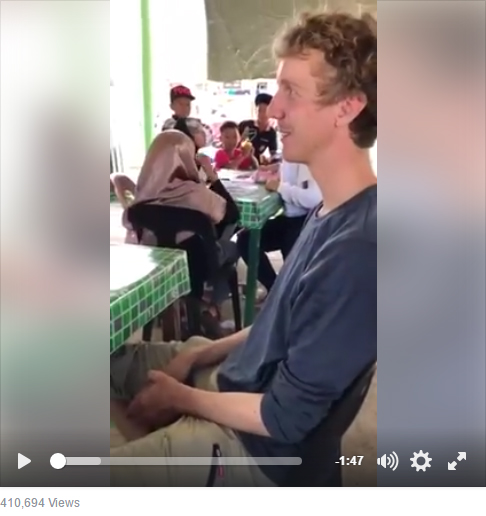 aditional genre.
Facebook Video with more than 400 000 views
After the conference, I stayed in Semporna for almost a week, and I realised that I have become a well-known figure in the area after the release of a Facebook movie from January this year in which I speal Central Sinama – the video now has more than 400 000 views.
During these days, I visited the communities of Labuan Haji, Bangaw Bangaw and Labuan Haji where many Sama Dilaut people without legal papers reside. I also visited some of the outer islands in the region where I met with Sama peoplewho are residing in their houseboats. I was joined by the American film makers Marlena Skrobe and Alice Bungan who are making a documentary about Sama Dilaut.
Famous Sama Girl Identified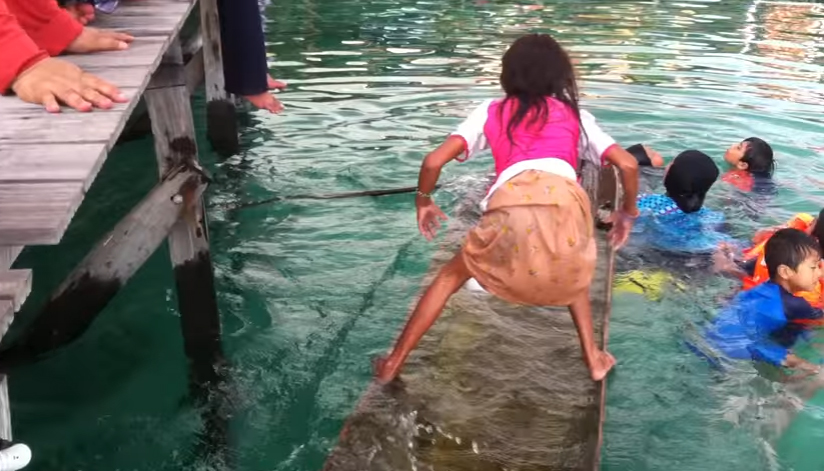
Also during this trip, I visited Mabul where I talked to Sulbin, the famous diver who walks on the sea floor in BBC:s movie “Sea bed hunting on one breath”. I asked him about his eardrums and he said that he had broken them for a long time ago “abostak na talingaku”, he said. He also said that it was very painful but that it is easy to harvest the sea floor after it’s done. In Mabul, I also identified the girl who saves her boat and help tourist children in another well-known video on Youtube. The girl’s name is Sial and she still lives in a houseboat outside of Mabul.
Sama Dilaut Photo Book as PDF
Here comes my Photo  Phook about Sama Dilaut as PDF: Sama Dilaut – People of the Sea. Over the years, I have distributed approximately 50 copies of the book, which is not for sale but given to people and organizations I meet.
At the moment, I am working on a new updated book that will touch more on Sama Dilaut’s culture and challenges as well as different fishing techniques. It will also contain my most recent photos.
Meeting with AAT Poster Designer Albert Chak in Hong Kong
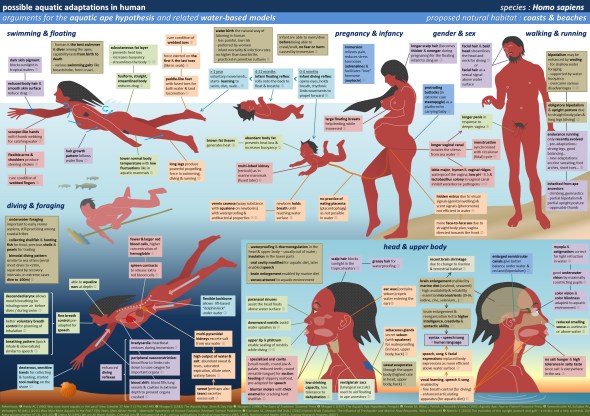
After the trip to Indonesia I made a short stop in Hong Kong on the way back to Sweden, where I met web designer Albert Chak whom I met in the Human Evolut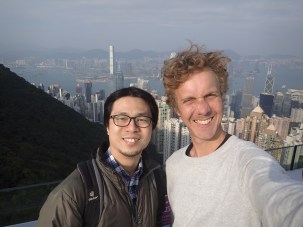 ion conference in London in 2013. He has a great interest in the Aquatic Ape Theory and has made two very informative posters on the matter, after carefully have studied the work of scientists in the field. In two intense days, we discussed different aspects of the theory, as for example it’s health implications and the emergence of speech. We also discussed how we can promote the theory among a larger audience.
My plan is to meet with many proponents of the theory around the world in the coming years as well as baby swimming centres and water birth institutions.
Conference in Semporna on Sama Dilaut
On March 23-27 the 2nd International conference on Bajau/Sama Diaspora and Maritime Southeast Asian Cultures will be held in Semporna, Malaysia. The conference will be about Sama Dilaut culture, sacred places, maritime lifestyle and migration.
I will present a paper on migration in which I discuss two possible solutions on the Sama migration crisis, derived from extensive field trips in Philippines, Malaysia and Indonesia. I argue that the crisis is part of an international problem facing coastal communities throughout the world, and claim that we should reclaim the concept of Sama Dilaut as guardians of the sea. Positive examples can be found in Sampela where Sama fishermen lead a traditional lifestyle within a national park and in Davao were Sama fishermen have been recruited as “Bantay Laut”, with the task of collecting plastic waste and report illegal fishing.
Life of Sama Dilaut – Broken Eardrums, Spear Gun Fishing and Indebtedness
From the end of December 2016 to the beginning of February 2017 I travelled in Philippines, Malaysia and Indonesia where I visited several Sama Dilaut communities. I talked to them about their daily lives, followed fishing and continued to learn the basics of two of their dialects, Central Sinama and Indonesian Bajo.
Noah – one of the last young boys who make a living from spearfishing in Davao
The trip started in Matina Aplaya in the outskirts of the metropolis Davao City in southern Philippines. Fish is on the decline and most people in the village make a living from vending of pearls, second hand clothes and shoes. However, a few families still make a living from the sea, and they are incredible divers.
I have been visiting Matina Aplaya every year since 2010 and I have always been accompanied by Issau and his son Noah. Noah is one of the few boys in the village who has grown up becoming a skin diver along with his father. On daily fishing expeditions, they spear fish and collect sea urchins, sea shells and clams in the coral reefs surrounding the town. It is fascinating to see that Noah has grown up to become a skilled fisherman who contributes to the household with his spear gun.
Zamboanga – Sama Dilaut resettlement after the 2013 fire
In 2013, the outskirts of Zamboanga were struck by a fire that destroyed thousands of houses and displaced thousands of Sama Dilaut and Tausug people. For months, they were living in a temporary camp in a sport arena close to the town centre.
After my visit in Davao, I made a two-day stopover in Zamboanga in western Mindanao before travelling to Tawi-Tawi. I visited some newly constructed villages set up by NGO:s and local authorities exclusively for the Sama, and many of the houses have been built in a traditional way. However, the daily life of many Sama Dilaut in Zamboanga is tough and it is getting harder and harder to make a living from the ocean. Many people are begging in the harbour. Yet others have fled to other cities in the Philippines.
Sitangkai – traditional dance in the Venice of the south
Despite recent kidnapping incidents in the Sulu I decided to travel to Tawi-Tawi in southwestern Philippines. I visited the Sama Study Center and the Marine museum in Tawi-Tawi where I met Rasul M. Sabal, the museum director. He has a keen interest in Sama Dilaut culture and show sincere concern with their challenges.

While in Tawi-Tawi I took the opportunity to pay a visit to Sitangkai along with Rasul M. Sabal and two policemen. Over the last years, very few foreigners have been in the area and I was fortunate to be able to visit the legendary community where thousands of people live in what is called the “Venice of the south” next to a tiny piece of land.
In Sitangkai, Sama elders performed religious dance that is normally performed during the magpai baha’u ceremony, an annual ritual taking place once a year in community (this year it will be held in May and it attracts Sama people from all over Sulu and Sabah). It was great to experience their hospitality and kindness!
I came to know that the interaction between Sabah and southern Philippines is intense despite stricter migration policies on the Malaysian side, and boats are heading between the locations more or less every night. In Sitangkai, I also saw how octopuses were shipped on a large scale to Tawi-Tawi and further to Zamboanga and Manila. However, the production of sea weeds has dropped due to reduced market prices.
Broken eardrums
After Tawi-Tawi, the initial plan was to take a ferry to Semporna, but the ferry company had lost its license so I took another ferry going back to Zamboanga instead. In the harbour of Bongao, more than 20 Sama Dilaut children were diving for coins, displaying great skills.
On the trip back to Zamboanga, I met two Sama brothers from Tawi-Tawi who were on their way to Palawan to join a fishing crew going deep in the South China Sea. They told me that they usually made use of explosives and compressors during these trips, and that the expeditions used to last for about one month. I asked them about their eardrums, and they said that they had broken them. Then, I asked them about their hearing ability, and they told me that their hearing was okay but that they had problems localising sounds. The brothers’ story is interesting since it has been unclear whether Sama fishermen break their eardrums or not. I would say that most the Sama Dilaut divers permanently rupture their eardrums, either on purpose or accidentally, and they take medicine in the case of infection. However, some fishermen do also equalize their ears and some may have hands free techniques for doing so.
When the ferry arrived in Zamboanga day after, the scene changed. Nearly 100 Sama begged for money in the harbour, including elders, and the atmosphere was more tense than in Bongao. It got obvious that life is very difficult in Zamboanga, and it is not surprising that so many Sama Dilaut are now roaming the cities of Manila, Cebu and other Philippine cities.


Meeting with Sulbin on Mabul
After the trip to Sulu, I made a short stop in Semporna where I went to Mabul to meet the Sama community there. I was lucky to meet Sulbin – the diver who walks on the sea floor for nearly two minutes in a widespread BBC production. He told m e that he had just come back from seasonal work in Kota Kinabalu. Hence, also the most skilled fishermen might choose to make a living in the job market rather than make their own fishing trips in the region!
However, in Semporna many Sama Dilaut still live in houseboats and they roam the many islands in search of fish, sea shells, clams, sea urchins and so on. Many of the more traditional Sama have no option but to continue extracting resources from the ocean.
Sama Dilaut spear-gun fishing women Wakatobi
After the short stop in Malaysia, I went on to Makassar in Indonesia where I met up with Professor Erika Schagatay from Mid-Sweden University, for our third trip together. We headed towards the island of Buton in southern Sulawesi where we spent a few days in the village of Topa (the sama village where Erika Schagatay first came in contact with Sama people in 1988). In the village, we followed fishing, talked to the people and made physiological research on Sama divers. For example, we measured the diver’s lung capacity, spleen size and feet size.
After the stay in Topa, we took a ferry to Wangi-Wangi in the Wakatobi island group. We spent one day in Wangi-Wangi before we visited the village of Samepla further out in the archipelago, where we spent four days. Sampela is located more than one hundred meters from the island of Kaledupa and have got attention in several film projects throughout the years, in for example BBC:s series “Hunters of th e South Seas” and the movie “The Mirror Never Lies”. During our stay in the village, we joined a group of women spearfishing, and it was fascinating to see their acquaintance with the ocean. We also followed fishing with Tadi, a 70-year-old fisherman who is still an incredible fisherman. He was the most successful fisherman during our trips, outperforming much younger spear gun fishermen. We also got the opportunity to measure Tadi’s spleen, and it turned out that his spleen is much bigger than peoples at the same age and with the same body size, and whom do not make a living from diving. The spleen is a very critical organ for experienced divers, since it consists of a high concentration of blood cells that can be released under pressure.
Also in Sampela, life is getting more and more difficult because of decline in fish. In the community, there is also a problem of indebtedness and large interest rates. Hence, many Sama fishermen are forced to increase fishing efforts despite recent decline in marine resources. Or in other words, they live on resources yet to be extracted.
Sampela is located within the Wakatobi National Park, but nevertheless, too little is done to prevent over-exploitation of the area. Big fishing boats enter the waters even though only small scale fishing methods are allowed. Hence, more must be done to reinforce the park regulations and to protect the area and the people living there.
Kabalutan – a pregnant woman showing great diving skills
My last visit in Indonesia took place in the community of Kabalutan in the Gulf of Tomini, central Sulawesi. Also this community is known from a few TV productions. Here, BBC produced a short documentary about Sama Dilaut with Tanya Streeter in 2007, in which young Sama children dive 12 meters repeatedly displaying great skills. This is also the place where Svea Andersson’s depicts a eight month pregnant woman diving for shell fish in the movie “Sulawesi, the last sea nomads”.
Along with two Sama families, I followed on a pongka fishing trip – a fishing trip at sea lasting for a few days. We stayed two nights at sea, collecting shell fish and spear-gunned fish. Among those who followed were 17 year old Muspang, the youngest boy in BBC:s movie with Tanya Streeter He is already a father and a great diver. However, I was more impressed by his mother, the same woman that was highlighted in Svea Andersson’s movie. Again pregnant, she was diving up to eight meters in search for shell fish and clams, as well as spear gun fishing. She is one of the last free diving Sama women with great diving abilities; one of the few remaining in not only Kabalutan but most likely in most Sama communities throughout Southeast Asia.
However, the amount of large commercial fish in on the decline also in Kabalutan, and it will be difficult for Sama people to sustain a living at the sea. Shell fish and octopus are still in quite big numbers since they mostly are being extracted using traditional fishing methods including diving, but other fish are rare. Who knows what life will look like after just 10 years when the consequences of coral bleaching and rising ocean temperatures will be much more severe than today?
Skillful 74 Year Old Sama Woman Dives for Coins Every Day
Lola Maria is 74 years old but still she paddles to the harbour of Lucena, Queszon, and wait for boat passengers to toss her coins which she’ll dive for – every day. She exhibits great diving skills reaching several meters on her hunt for coins and she can get approximately 100 pesos daily, some of which goes to send her grand children to school.
Like most Sama people in Luzon in northern Philippines, Lola Maria orginally came from Zamboanga. She tells us a story that we have heard many times before: a lot of Sama people lead a difficult life on the run, in a world with less fish and more tensions, yet surviving by cooperating closely over generations and taking advantage of their inherited skills.
in August 2016, Lola Maria, was featured in a GMA News’ Front Row documentary titled “Mga Barya ni Lola Maria” (The Coins of Grandma Maria).


Bajau Laut Architecture as Inspiration for Green Movement
Bajau Laut are famous for their stilt houses that are built meters above the sea level. Islands like Maiga, Denwanan and Pulu Gaya in Semporna attracts thousands of tourists every year for their fascinating houses and people.
This architecture can be a great source of inspiration for the green movement, as described in ArchDaily and their article 5 Architectural Secrets of the Badjao: 21st Century Sea People (though it contains some minor errors regarding Bajau Laut’s history and geographical expansion).
The key words in Bajau Laut architecture is adaptibility. In west, we generally aspire for solidity, thick and immovable construction, and maximum fortification. We don’t build with the elements, but in order to master them, to control them. The Bajau Laut, on the other hand, have learned how to live with the elements and to adapt their construction to the natural environment. Hence. waves, floods and erosion will be a minor problem for Bajau’s settlements – but at the same time thay will have a closer access to sea life than anyone else.
Bajau Laut build short term, and live long term. They continuously replace older materials and they use whatever they can find in their natural surroundings. They have simply accepted the fact that they can’t change the flow of water.


Guardians of the Sea – “Bantay Laut”
The Bajau of Matina Aplaya – where I have been staying for several months – have been recruited as auxiliaries for coast guard and maritime police in Davao. They have been given a number of fiberglass motorized fishing boats and will report illegal fishing activities fronting their communities and gather garbage floating in the sea. The fishermen will also receive a honorarium on the condition that they will let their children undergo a basic literacy program. The programme is called “Bantay Laut”.
The idea of involving local communities in maintaining sustainable fisheries is great, and will recreate Bajau’s traditional role as guardians of the sea. However, the political linkages must be taken into account and the teaching should not interfere with Bajau’s culture and way of life. In a whole this is great news that contrasts with the negative news we often hear about Bajau Laut in the Philippines and Malaysia. At last, the Bajau Laut are being treated as actors.
The news has more than 11 000 likes on Facebook and more than 3 500 shares.


The Invisible Kids
AJ+ has published a new movie about the situation of kids in Semporna, Sabah, Malaysia: “The Invisible Kids”. A majority of the people in the movie are Bajau Laut who stay without legal documents in Malaysia.
The Malaysian government started to deport illegal migrants on a higher scale after the Lahad Datu terrorist attack in 2013, where sex civilians and ten Malaysian security forces were killed. But the problem is that innocent stateless people without political connections also get affected. How many Bajau Laut claim that Sabah should be a part of the Sultanate of Sulu? Very few – the sultanate was just another empire they were alienated from. A majority of the Bajau Laut just want to live their lives in peace.
Bajau Laut have been living in the region for centuries, before any formation of national states. They do not belong to “Philippines”, “Malaysia” or “Indonesia”.
Shark Poster in Simana
The linguist Luke Schroeder has made a shark poster in Sinama. Still today many elder Sama Dilaut have great knowledge about different shark species and their habitats and nature.
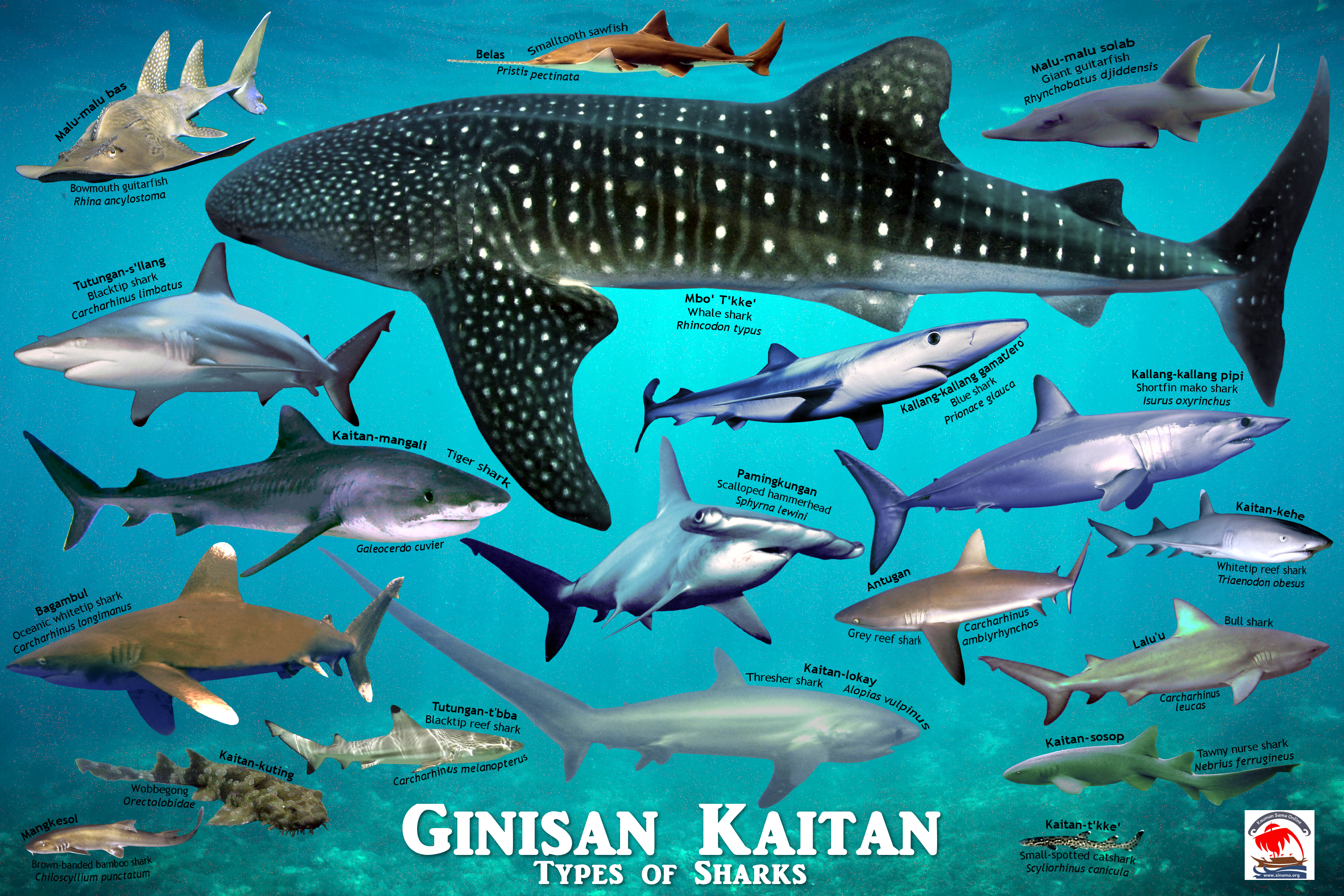
Luke Schroeder has put a great effort in making the poster, talking with many Sama fishermen. When pictures have not been enough, he has interviewed Sama men on the behaviors and nature of the sharks which Luke has been able to link to scientific descriptions of the sharks.
The older generations of Sama still have a great knowledge about sharks, but the younger fishermen are much less familiar with the sharks behavior and nature.
Over exploitation of sharks has made shark fishing illegal throughout Southeast Asia. Also Bajau Laut fishermen have contributed to the near extinction of many shark species, largely driven by a great demand for shark fins.
Luke Schroeder has also published a poster about coral fish in Sinama, which can be found on his website: Common Reef Fish Sinama, English, & Scientific Name Poster.
Sama Girl in Metro Manila get Famous
During a festival in Queezon City a photo was taken of a 13 year old Sama Dilaut girl begging in the streeets with her younger sibling. After a while the photo got viral on Facebook and other social media. Today she has been modeling for several newspaper and been awarded a scholarship. Her name is Rita Gabiola
Why is she getting famous? Does it require beuaty to get a scholarship and support? Many Sama Dilaut have been deprived of their livelihood and they are discriminated. Throughout Metro Manila and other big Philippine cities they are now making a living from street vending, bicycle taxi an begging.
In Philippines, more than 10 % of the population go overseas for work and send money back to their relatives. But how many Sama Dilaut can go overseas for work? Who is sending money back to them?


Bajau Laut Kids Dive 12 Meters
In this short BBC video clip from 2007 we can see Bajau Laut kids who dive 12 meters over and over again. They have an amazing speed, technique and coordination!
The movie was recorded in the Gulf of Togian, Sulawesi, Indonesia, with freediver and TV personality Tanya Streeter. How far-fetched is the idea that we actually are semi-aquatic mammals?
New Report: More Plastic Than Fish By 2050
By 2050 there will be more plastic than fish in world’s ocean, accordning to a new report from World Economic Forum. Most of the trash that gets into the ocean comes from land, not from cruise ships or fishing boats. More than 8 million of plastics are being thrown into the ocean every year.
Half the plastic in the ocean comes from five countries: China, Philippines, Indonesia, Vietnam and Thailand
You can find the report from World Economic Forum here: The New Plastics Economy Rethinking the future of plastics.

Attending 1st Sama Dilaut Conference in Tawi-Tawi
Between December 1 and 3 I participated in the 1st Sama Dilaut (Philippine Badjao) International Conference on Sanga-Sanga Island, Tawi-Tawi. I was invited to make a presentation about our previous research on the Sama Dilaut, together with research colleague Professor Erika Schagatay. More than 200 people attended the conference, including local Sama Dilaut elders, researchers from Philippines, USA, Sweden and Japan, local government officials, filmmakers from USA and representatives from the Philippine council of UNHCR.
The conference was surrounded by a lot of security precautions due the insecure political situation throughout southwestern Philippines. The co-chairman of the conference Professor Abduljim Hassan from Mindanao State University, was very happy to receive international guests, not only as it showed there is an international interest for this conference but also as their presence send a signal of stability in the Tawi-Tawi region. ”After the French terrorist attacks I thought that none foreigner would come”, he said, “but I was very glad when I heard that they would come to attend the conference.”
In addition to academic presentations the conference included cultural exhibitions about Sama Dilaut, as for example traditional dance and music, and a silent theater depicting the traditional boat life of Sama Dilaut. In the last day of the conference we also got the opportunity to visit the island of Siminul which is home to the oldest mosque in the Philippines.


Subsistence Diving Among Sama Dilaut
During the conference, Erika Schagatay and I presented an abstract titled ”Three profitable freediving strategies used by the Sama Bajau – marine hunter-gatherers ”, in which we described traditional freediving speargun fishing, net fish drive by divers and see harvesting of tripang and shell fish. We showed the important physiological adaptations in humans that make it possible for them to lead a lifestyle based on freediving. Our full article will be published in the beginning of 2016.
We also gave examples of the fact that many Sama Dilaut still lead a successful traditional life in many places despite the hardships they face in many regions throughout Southeast Asia, where over fishing with modern equipment threatens their way of life. Hence, we should not only talk about the problems facing the Sama Dilaut, but also about their unique and beautiful lifestyle and its prerequisites, and how it can contribute to a sustainable use of marine resources.
Anthropologist Harry Nimmo is still Remembered in Tawi-Tawi
In the first day of the conference we also had the opportunity to listen to a recent filmed interview with the anthropologist Harry Nimmo, who made long field work among the Sama Dilaut of Tawi-Tawi in the 1960’s. The film was made by the filmmakers Alice Dugan and Marlene Skrobe, which attended the conference. Harry Nimmo, the writer of the book “Magosaha – An Ethnography of the Tawi-Tawi Sama Dilaut”, depicted Sama Dilaut’s boat living lifestyle back in the 60’s and told how their lives were influenced by tidal waves, winds and currents. A few Sama Dilaut elders who attended the conference said that they still remember Harry Nimmo from his earliest field work. “He had his own houseboat”, one man said.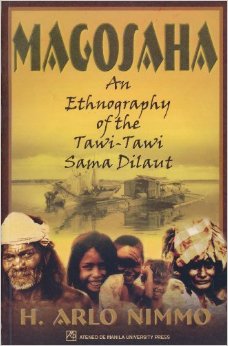
In the filmed interview Nimmo also said that much of the lifestyle that he encountered in Tawi-Tawi during the 60’s had disappeared when he later returned for short trips in the 70’s 80’s and 90’s. However, we should keep in mind that many of the elements that were described in his book Magosaha can still be found in other parts of Malaysia, Philippines and Indonesia. In Semporna, Malaysia, to where many Sama Dilaut from Tawi-Tawi have fled during later years, hundreds of Sama Dilaut now live in houseboats. In Sitangkai, Philippines, big traditional healing ceremonies are still being held on an annual basis. In Davao, Philippines, and in Sulawesi, Indonesia, traditional speargun fishing with homemade googles, spearguns and swimming feet is still thriving. In Sampela, Indonesia, many Sama Dilaut still place the placenta – “the twin child” – in the ocean after birth, just to give some examples.
Sama Dilaut Elders Expressed their Concerns
Many Sama Dilaut elders from Tawi-Tawi who participated in the conference raised their concerns about their everyday life. One recurring point was that their catches often gets stolen at sea. Another major concern was that they have to rent the land where they live, and that there was not any land where they could bury their dead. They also said that many of their relatives have fled to Sabah, Malaysia and that they cannot see their relatives because of national borders, despite the fact that they are living close to each other in geographical terms. ”I haven’t seen many of my children for decades”, an elderly Sama Dilaut woman said.
Rosalyn Dawila Venning from the Malaysian NGO PKPKM Sabah explained that the Sama Dilaut of Semporna do not have any right to schooling or medical care and they are under a constant threat of deportation. Helen Brunt, a British anthropologist who has stayed in Sabah for seven years, was supposed to make an online presentation about the Sama Dilaut in Semporna, but couldn’t do so because of technical issues. She has written about Sama Dilaut’s difficult situation in her dissertation thesis: ‘Stateless Stakeholders: Seen But Not Heard?’
According to Rosalyn Dawina Venning certain “house boat” passports were once issued to secure Sama Dilaut’s right to freely roam the waters of Philippines and Malaysia, but these passports were early exploited by other groups for illegal fishing and crossing of borders. One member of the audience claimed that he himself had managed to get a “house boat” or “lepa” passport a couple of decades ago even if he is not a Sama Dilaut. “There was an inflation in passports”, he said, “and the Sama Dilaut had to suffer; now they lack documents to legally cross borders again”.
“Badjao”– a term Dismissed by the Sama Dilaut
In Philippines, the word Badjao is being used to denote the Sama Dilaut, and they are now known throughout the country in big cities as Manila, Cebu and Iloilo as coin divers, recycled drum musicians, beggars and street vendors of pearls and second hand clothes. However, as concluded by Nazer H. Aliaza in his presentation “The Sama Dilaut (Badjao) Migrant in Metro Manila” very few of the Sama Dilaut who live in major Philippine towns are actually from Tawi-Tawi. In fact, none of the families interviewed by Nazer H. Aliza in Manila came from Tawi-Tawi, but from Zamboanga, Basilan and Jolo in the northern Sulu.
Accordning to Harry Nimmo there have been three groups of Sama Dilaut that have traditionally lived on boats, one from Tawi-Tawi, one from Sitankai and one from northern Sulu. Hence, when the Sama Dilaut are mentioned in Philippine media as “Badjao” it is mostly the northern group that are stressed. Unfortunately, no representatives of this population participated in this conference and I think it is crucial that also they get the opportunity to speak in any future Sama Dilaut conference. The term “Badjao” is a derogatory term which is neglected by literally all Sama Dilaut in Philippines, and the word should not be used.
Are they Refugees or Internally Displaced Peoples?
One of the organizations that attended the conference was The Philippine Council of UNHCR who discussed UN:s role in facing the hardships of Sama Dilaut. According to the spokesperson of UNHCR the Sama Dilaut who are displaced within the Philippines can’t be recognized as refugees since they have not left any national border. It is also questionable if the Sama Dilaut who have fled to Malaysia can be considered as refugees, because there is still a border conflict between the Philippines and Malaysia about the Sabah region in eastern Malaysia. ”The border is not yet established”, the spokesperson from UNHCR explained. There is also a matter of ancestral territory. “The Sama Dilaut has roomed the waters of southwestern Philippines and eastern Malaysia for centuries, so the flight by Sama Dilaut from Philippines to Malaysia will not automatically be considered as a flight from one national state to another, but rather as a movement within their ancestral domain”, the spokesperson told me. In the meantime the Sama Dilaut of Sabah suffer a lot, and without a refugee status they cannot get the attention their problems deserve, a major one being that they seem not to be considered to belong anywhere. In that sense they are “homeless” despite a long history in these waters and archipelagos.
Marine Reserves – Will they Benefit Sama Dilaut?
There were also discussions about marine reserves during the conference. Some Sama Dilaut wanted newly established reserves in the Tawi-Tawi region to be available for fishing, while marine conservatists claimed that the reserves are crucial for a sustainable fishing and that “no take zones” will benefit the whole region. The marine biologist Dr. Filemon G. Romero, he himself a Sama, claimed that the main reason why many Sama Dilaut have left the Sulu Sea for either urban Philippine areas or the Malaysian coast of Sabah is not only because of the unrest in the region, but because of reducing populations of fish. ”In recent decades there has also been a drastic decline in fish”, Dr. Filemon G. Romero explained. “Marine reserves are crucial for the survival of the Sama Dilaut in the Philippines”, he said.
“Sama Dilaut are Marine Biologists”
Erika Schagatay pointed out that the Sama Dilaut are experts – they are actually marine biologists. “We should learn from them”, she said and many people agreed. Sama Dilaut are really experts on the marine life, they know most species of fish and invertebrates, and they have a deep knowledge on animal ethology, sea currents, tides and weather conditions. But nevertheless, destructive fishing methods are being used by many groups in the region, and also among some Sama Dilaut. There is an old belief among Sama Dilaut that fish will always be re-created, which was likely true using only traditional fishing methods. With the introduction of commercial big fishing boats and less sustainable fishing methods a deeper understanding of the ocean’s vulnerability must be disseminated among the Sama Dilaut and other fishing groups across the Sulu Sea. It was pointed out that in some regions of Indonesia, nature reserves combined with traditional Sama fishing had been successfully combined.
Sama Dilaut Future
During the ending discussions of the conference it was a pleasure to see how the speeches of Sama Dilaut elders were received. No one received as much applause and encouragement as they did, even if their talks were only briefly translated to English. But their main problems being that have no land, little income and no political power – how will their situation best be improved?
The real issues about security and access to land were not discussed in proper detail. However, it is good that scientist and decision makers have met and started to discuss these crucial questions. It is also very important to give international attention to the topic. If international actors put pressure on local decision makers, change will be more likely to take place. However, representatives from Malaysian and Indonesian local and national authorities were absent. Perhaps an important step is to realize the common issues concerning the Sama populations across these nations?
If the international community puts pressure on the national governments of Malaysia, Philippines and Indonesia, so that Sama Dilaut get fully recognized by local and national authorities and their deserved rights –, if well managed national marine reserves are formed with only traditional or no fishing allowed, and if zero tolerance for large-scale and environmentally harmful fishing is introduced in key regions, and resources provided to enforce these rules – then both the sustainable life of Sama Dilaut and the waters of the very heart of the coral triangle might face a bright future.
Study on Sama Dilaut Divers in Philippines, Indonesia and Malaysia
In the end of 2015 I together with three companions made a scientific expedition in Southeast Asia. We visited four different Sama Dilaut communities in Philippines, Indonesia and Malaysia with the intention to meet some of the best Sama Dilaut divers. We stayed with several families, where we followed Sama Dilaut underwater fishing and made measurements in order to throw light on the physiological factors behind a diving based lifestyle.
The trip was partly funded by the Mid-Sweden University and planned by Erika Schagatay, Professor at department of Health Science at Mid-Sweden University. Other participants were Itamar Grinberg, a professional photographer and Orio Johansson, a third year Medicine student at Lund University, doing a project with Erika´s supervision.
We documented traditional Sama Dilaut fishing methods involving diving, as for example speargun fishing (”amana”), net fish drive (”ngambai”) and sea harvesting (anꞌbba”). We logged Sama Dilaut diving patterns using Ultra Sensus Loggers, in order to determine their diving depths and durations. We also measured their lung capacity in relation to height and weight, measured the size of the fishermen’s spleen´s which contract during diving and releases red blood cells, and determined their diving responses, a mammalian diving reflex that makes the pulse beats slower and redistribute blod to the more vital organs – all three important factors to become a successful diver.


Speargun-fishing in the Gulf of Davao
In the Philippines we visited the Sama DIlaut community of Matina Aplaya in Davao City, where some fishermen still rely almost exclusively on traditional breath-hold diving speargun fishing. For four days in a row we went fishing spending hours a day at sea in the picturesque environment of the Gulf of Davao. During the fishing trips the Sama Dilaut covered large distances by boat to reach good coral reefs for fish. However, the number of big fish is reducing and it’s getting increasingly difficult to make a living from fishing, although a big catch of coral fish now gives a higher price on the market today than it did in the past. The Sama Dilaut blame local speargun fishermen using compressed air at night for the decline in fish, even though large-scale commercial fishing is also common in the area.
At the same time, the Sama Dilaut are positive to newly established protected marine areas in former fishing grounds around Davao. ”If the fish gets a chance to grow up, it will eventually leave the sanctuary and benefit our fishing”, the community leader Edjie Adjari explained.
Fishing with the TV-star Kabei and his brother
In Indonesia we visited two Sama Dilaut communities outside the southeastern coast of Sulawesi. We revisited the village of Topa, where we went diving for two days with some of the most skilled divers, and logged their dives. We did also have the opportunity to witness a traditional healing ceremony which included offerings at sea.
In Sampela, Indonesia, we met the underwater fisherman Kabei and his brother Laudo, who were recently visited by BBC:s Will Millard for the series “Hunters of the South Seas”. You can see a clip of the program here: Spear fishing with the Bajau.
We followed the brothers and three other skilled diving fishermen from the community during two days of speargun and net drive fishing. Sampela is located within the Wakatobi National Park and only traditional fishing methods are allowed here. The difference from Davao was striking – in only a few hours of speargun fishing without moving anchorage the five fishermen caught more than 30 kg of coral fish. In the reef closest to the village, Kabei even managed to find two lobsters.
However, also in Sampela fish is on the decline and both an increasing pressure from commercial fishing boats and a rise in sea temperature are major threats. According to our host Pondang it is also common that fishermen from the village migrate to Johor or Ambon, where price for fish is higher. ”In Sampela the price for fish is still very low but the cost of staple food as cassava, rice and water increase”, Pondang explained. In Sampela we also went sea harvesting for tripang, sea urchins, clams and other types of shellfish with Sama Dilaut women and in one hour of diving they got a substantial catch. However, on the market in Mola, located in the biggest island Wakatobi, we concluded that the worth of the women’s catch was not more than a few dollars.
Stateless divers in Semporna, Malayia
In Semporna, Malaysia, we tried to come in contact with the world known free diver Sulbin who walks on the seafloor in another BBC production, Sea Bed Hunting On One Breath – Human Planet. However, he and other stateless people from the famous tourist island of Mabul had left for Kota Kinabalu for seasonal work. Luckily, we came in touch with other Sama divers, originating from the places as Sulbin, Siasi in the Philippines, and followed them fishing to Omadal island where fishing was good.
In Semporna many Sama Dilaut are still living their entire lives on traditional house boats. Thanks to marine sanctuaries and a strong marine tourism fish is still plenty in the region. However, only the coral reefs of Sipadan have recovered to close to what they used to be before the introduction of new, destructive fishing methods mainly in the early 1970’s (Sather 1997: 119). The traditional fishing methods used by the Sama Dilaut are more sustainable, as mainly the big fish are caught.
Preliminary Findings from the Expedition
The preliminary findings from our expedition is that Sama Dilaut fishermen regularly stay more than 50 % of their time submerged while spearfishing. A typical diving shift lasts for 2-3 hours and three such shifts can be carried out during one day. The best fishermen have an underwater bottom time on up to 60 % – as we also have concluded in earlier studies. The summarized findings from our expedition, including findings on lung capacity, the size of the spleen and the diving response, will be published later.
References
Sather. Clifford (1997) The Bajau Laut: Adaptation, History, and Fate in a Maritime Fishing Society of South-eastern Sabah. Oxford:OxfordUniversity Press.
New Report from WWF: No Coral Reefs Left at 2050
A new report from WWF about the health of the world’s ocean was published o September 16, 2015. The Living Blue Planet Report provides a very accurate but also very sad picture of the state of the ocean:
- it shows a decline of 49% of marine populations between 1970 and 2012,
- worldwide, nearly, 20 per cent of mangrove cover was lost between 1980 and 2005,
- more that 5 trillion plastic pieses weighing over 250 000 tonnes are in the sea.
“In less than a human generation, we can see dramatic losses in ocean wildlife — they have declined by half — and their habitats have been degraded and destroyed,” said Mr Brad Ack, senior vice president for oceans at WWF.
Climate change and warmer oceans will make the situation worse, although fishing restrictions will be implemented. If current rates in temperature rise continue, the ocean will be come too warm for coral reefs by 2050. In this scenario it’s hard to see a future for Bajau Laut and other people who live on shallow water fishing and gathering.

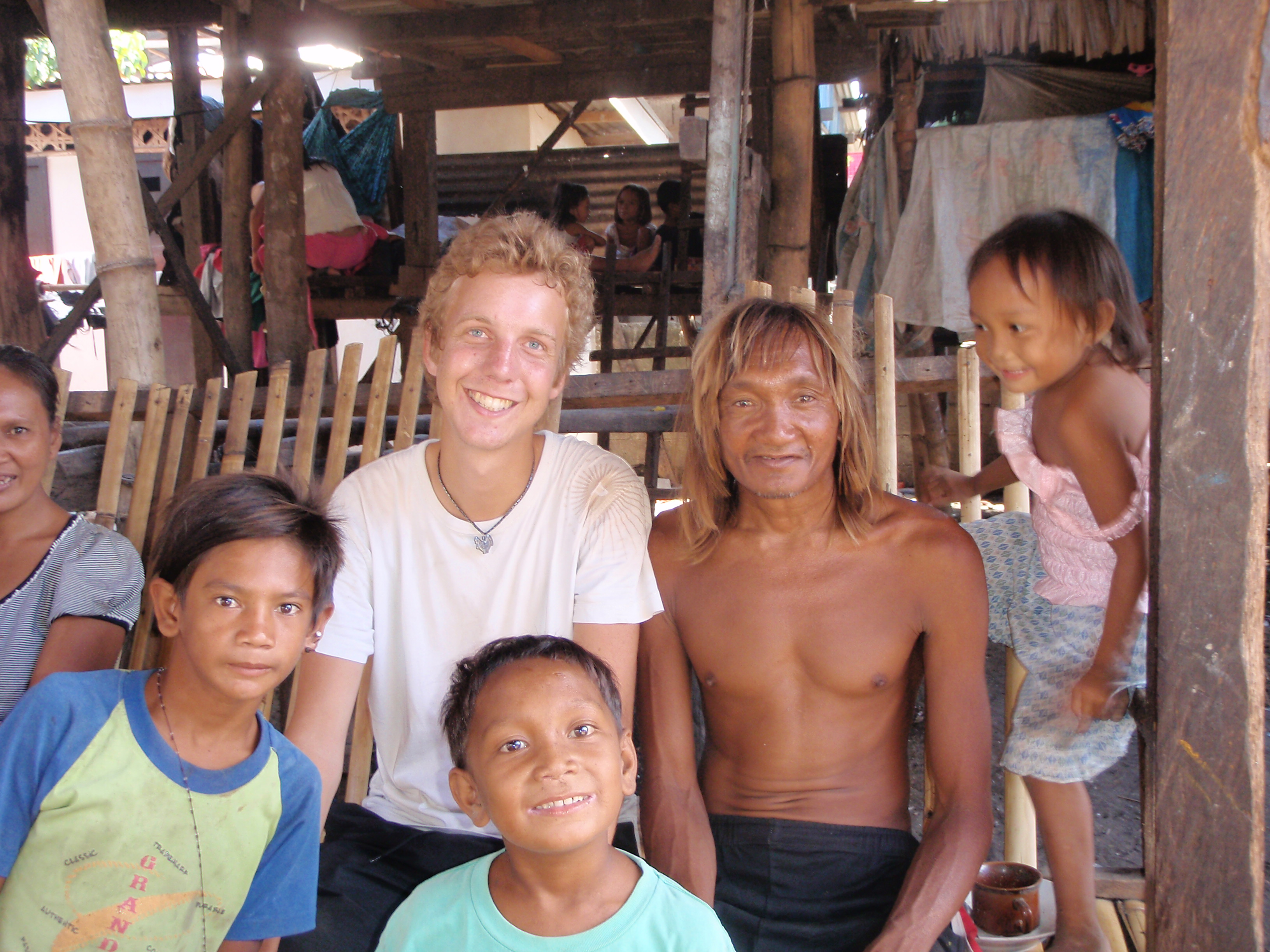

 The Aquatic Ape