For a Living Ocean

Latest

Lucy – Was She Living in a Lake Margin?

In the end of June I went to Addis Ababa, Ethiopia, were I visited the National Museum. Here the remnants of the world’s most famous fossil, Lucy, can be found. The skeleton is 40% complete and is estimated to be 3.2 million years old.

Lucy was discovered in 1974 near Hadar in Ethiopia, by Donald Johanson and his colleague Maurice Taieb. She was classified as Australopithecus afarensis.Donald Johanson and others have suggested that Lucy had been living in a mosaic environment (forests, grasslands, lakes). However, the fossil of Lucy was found next to crocodile and turtle eggs and crab claws (Johanson & Taieb 1976).

Today the excavation site lies in a dessert, but 3, 2 million years ago the area were green and flourishing. Many scientists have suggested that Lucy fell in to a lake after she died – but perhaps lake margins was the biotope she preferred? Probably she was actually feeding from the lake.

Throughout the years, the so called Aquatic Ape Theory has been ridiculed – even if the most famous fossil was found next to crocodile eggs and crab claws.

However, the distinct adaptation to a water-based lifestyle took place later. Homo Erectus was probably much more adapted to an littoral environment than her Australopithecine forefathers – as a swimmer and free-diver (see earlier posts).

In the National Museum of Ethiopia you can also find see the skulls of Omo 1 and Omo 2, the oldest fossils of Homo Sapiens ever found. They are estimated to be around 190 000 years old. Today, the Omo Valley of Ethiopia is one of the most unique places on earth because of the wide variety of people.

References

Johanson, D.C., and Taieb, M., 1976, Plio-Pleistocene hominid discoveries in Hadar, Ethiopia: Nature, v. 260, p. 293–297

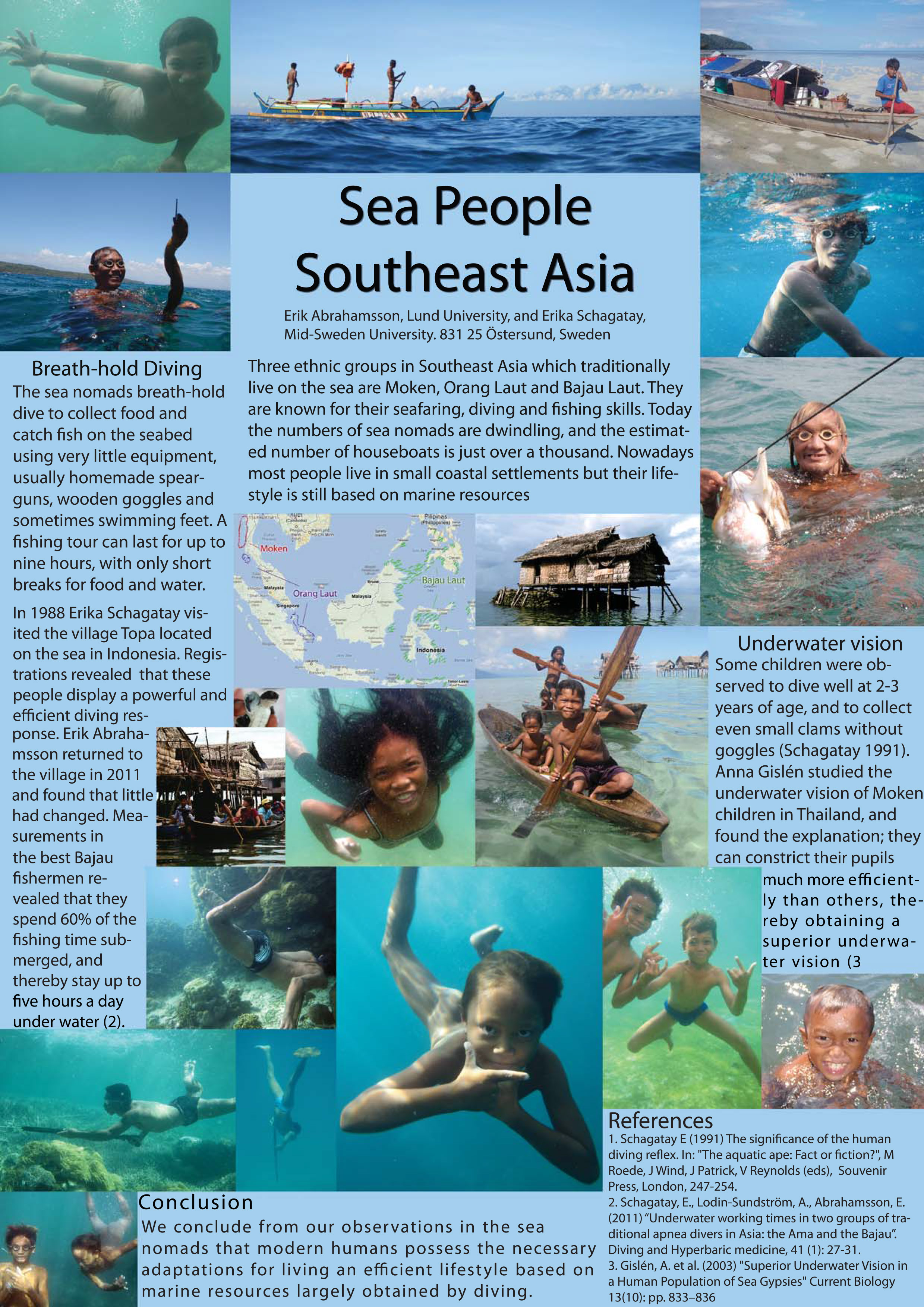
Poster about Sea Nomads in Southeast Asia

During the Conference on Human Evolution in London me and Erika Schagaty presented a poster about sea nomads in Southeast Asia, where we summarize some of the key observations and conclusions we have made during our work with Bajau Laut. Erika Schagatay met Bajau Lautin eastern Indonesia and Orang Laut in western Indonesia already in the 1980s. Sea Nomads of South East Asia final.pdf

Poster information:
Abrahamsson, E and Schagatay E. (2013-05-09) Sea People – Southeast Asia.
Presented at Human Evolution Past, Present & Future – Anthropological, Medical & Nutritional Considerations


“Homo Erectus were Shallow Water Divers”

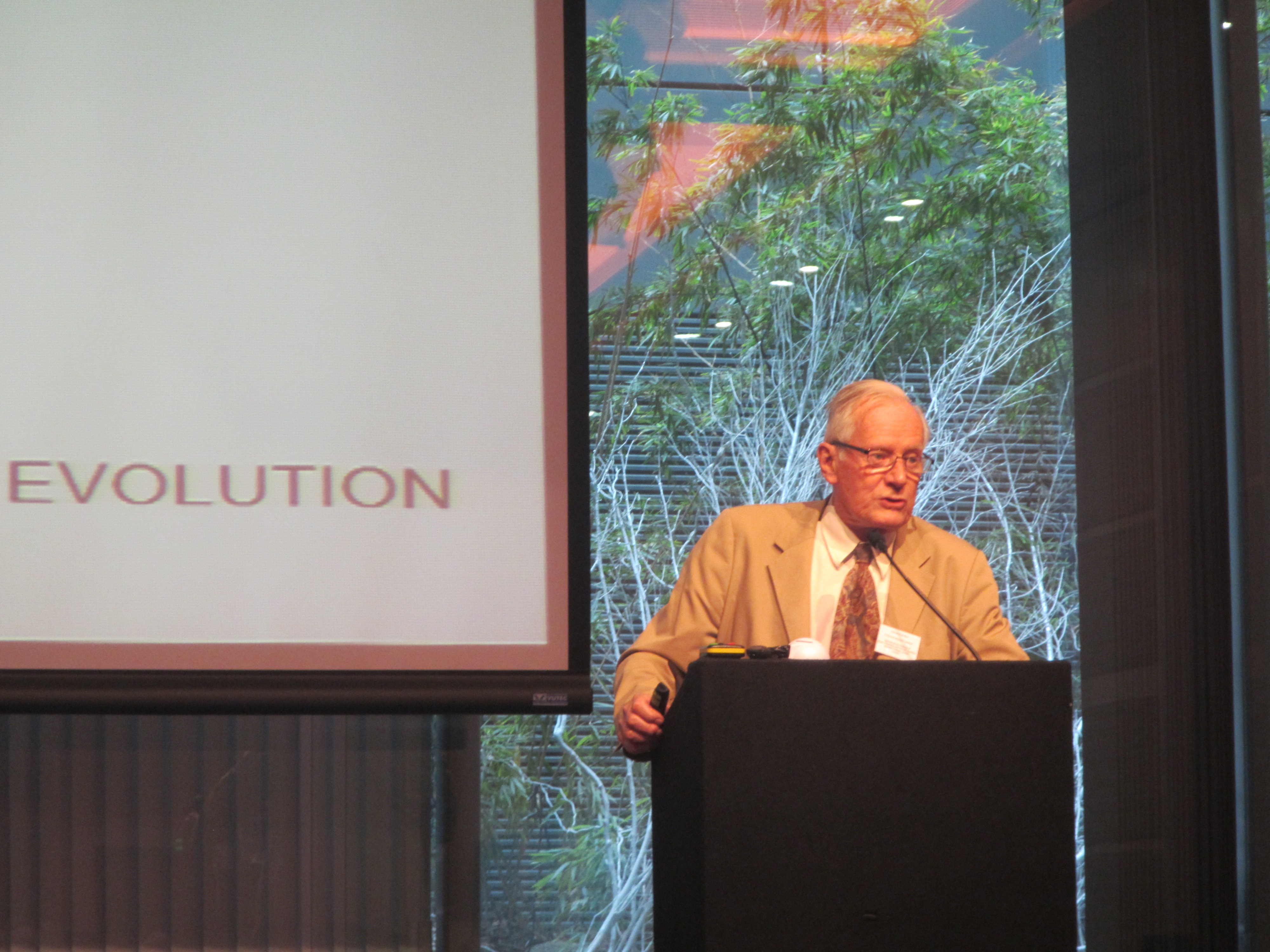
Between 8th-10th on May researchers from all over the world gathered in London, presenting new research on human evolution, health and migration – with focus on the so called waterside theory. During the conference we could hear about swimming babies, water births, free diving, indigenous diving, underwater vision, surfer’s ear, coastal migration, bipedalism, aquatic mammals and much more.

Outspoken critics to the aquatic ape theory were also present, as for example Donald Johanson and John H. Langdon. Already in the first session, Donald Johanson declared that the so called aquatic ape theory is nonsense – before he had even heard the arguments that were to be presented during the conference.

The Aquatic Ape Theory has changed since it was first publicized by Alister Hardy and Elaine Morgan. Initially most proponents suggested that human ancestors spent a period of time on the coastlines after the separation from the forefather of the chimpanzee (5-7 million years ago), and then left for land. But nowadays many of the leading waterside scientists suggest that the evolution to a marine environment continued.

Marc Verhaegen – one of the organizers of the conference – presented a controversial idea that Homo Erectus likely were shallow water divers. As a matter of fact their migration out of Africa was made exclusively along coastlines or rivers, and Homo Erectus had much larger brains and skulls than their predecessors (among many marine animals big skulls are equivalent to shallow diving). According to Verhaegen, Homo Erectus were much more adapted to a marine environment than for example Lucy and her species Australopithecus Afarensis. It is now clear that our big brains and sinuses as well as our voluntarily breath control evolved during Homo Erectus time on earth – which is highly likeable due to a rich intake of marine food and much time spent in water. Probably did also physiological traits as the human diving response, neonatal swimming reflexes and diving reflex evolve over time, not only during a short period of time 5-7 million years ago.

Hence, human evolution in an aquatic environment water was not only a historic incident that took place in Africa millions of years ago, but was an ongoing process throughout evolution of human beings. Our present aquatic adaptations are not remnants from an old way of living, as initially suggested by professor Alister Hardy and Elaine Morgan, but adaptations that were crucial also in the emergence of Homo Sapiens 200 000 years ago.

However, this theory is hard to accept within the anthropological community as they strongly emphasize a mosaic environment, suggesting that human beings were living in different environments throughout human history, just as we are living today. Human beings are thought to be able to live in any kind of environment and are not considered to be environmental specialists. But we can’t ignore that Homo Sapiens during most of her time as a living species has been living in an tropical environment feeding from an marine environment. As a matter of fact, we started to live on dry open spaces, like savannahs, much later.

Several newspapers wrote about the Human Evolution Conference, partly misunderstanding and misinterpreting the waterside theory. For example, Independent asked if “did humans come from the sea instead from the trees?”

Then – what can we learn from the new perspectives in the waterside theory? We have to start to accept that human beings have evolved in the same way as all other creatures – living predominantly in one habitat occupying only a small number of niches. We have not always been environmental generalists and we are still today – physiologically and biologically – much more adapted to a life along coastlines than a life on mountains or savannahs.

Declining fish stocks might give “crucial consequences for our species”

The world’s fish stocks are decreasing. It is estimateds that 90 % of all big fish are already gone. Dr. Michael Crawford, of Imperial College London, sys that “without plentiful DHA, we face a future of increased mental illness and  intellectual deterioration. We need to face up to that urgently”. Docosahexaenoic acid (DHA) is an omega-3 fatty acid found in seafood. You can find the article in Mail Online here: Early human ancestors were ‘aquatic apes’: Living in water helped us evolve big  brains and walk uprigIMG_7782ht, scientists say.

Michael Crawford – one of the speakers at the Human Evolution onference in London 8-10th of May –  states that Docosahexaenoic acid have been crucial for the development of our brains (as well as for other mammals making a living from the sea). According to Crawford we should eat 40 gram fish per day, 200 days a year.

However, by improving our mental health we will also completely undermine the marine stocks – and what will happen when we are another two billion people on the earth? Add overfishing to pollution, climate change and habitat destruction, and a picture of a system in crisis emerges.

Conference on Human Evolution in London

On May 8-10th The Royal Marsden organizes a conference on Human Evolution – Past, Present and Future in London.

In the conference, scientists will present new research and evidence highlighting the connection between humans and an aquatic lifestyle, as for example breath-hold diving, sea food/nutrition and water birth. Among the invited guests are Donald Johanson (the discoverer of Lucy) and David Attenborough (broadcaster and naturalist).Was Man more Aquatic in the Past

This conference clearly indicates that the Waterside-hypothesis (popularly the Aquatic Ape Theory) is getting more accepted in the scientific community. More and more scientists are now accepting that water has played an important role in human evolution, but the question is how big the aquatic impact has been.

Here you can find the program: Human Evolution Past, Present & Future – Anthropological, Medical & Nutritional Considerations.
Change in the programme for the second day: Day 2. Scars of Evolution

Visitors are welcome to admit posters on human evolution that will be presented during the conference.  Prof. Erika Schagatay at Mid-Sweden University and I will present a poster on sea nomads of Southeast Asia focusing on their underwater vision, breath-hold diving and sea harvesting skills – characteristics that demonstrate that human beings still today can be highly adapted to the sea. I have also been invited to give a speech on Bajau Laut and their adaptations to the sea. See you in London!


The Placenta is Thrown into the Ocean

Bajau Laut have been living in Southeast Sulawesi since the 16th century. Originally, they were involved in the spice trade, transporting lucrative spices from Moluccas to Borneo. When the Dutch colonialists changed the trade routes many Bajau Laut stayed on their houseboats made a living completely from sea harvesting. Some do still today.

WWF in Wakatobi

Most Bajau villages on Buton and Wakatobi in Southeast Sulawesi were created only one or two generatiImageons ago, when Bajau sea nomads settled in pile houses.

In one of the villages of Buton, Lasalimu, I met Sadar, a Bajau who works for WWF in Wakatobi. His work is to persuade Bajau fishermen stop dynamite fishing. “In Wakatobi we have been quite successful but further north many Bajau use fish bombs and cyanide”.

In Wakatobi most fishermen make a living from skin diving, as compressors are illegal. “We also try to regulate how much fish they can catch a day”, Sadar told me, “it is necessary because they are fishing in Wakatobi National Park”.

Sadar also told me that it still is practice among some Bajau to throw the placenta in the ocean after giving birth. They believe that the child will protect the sea as “it is the home of their sibling”. You can read more in this article in Al Jazeera: Indonesia’s last nomadic sea gypsies  (2012-10-06).

Born on the sea

After my visit in Buton I headed north to Lasolo where many Bajau Laut are living on small, isolated islands. Around these islands, many Bajau used to live on the boats till only a few years ago. More or less everyone above 10 years old were born on the sea.

The author of Outcasts of the Islands,  Sebastian Hope, visited Lasolo in the last decade and met sea nomads close to Boenaga and island of Labengke in Lasolo. But today all of them are living in houses.

In the Gulf of Togian in northern Sulawesi, however, it is still possible to find Bajau Laut who have been on the boat their entire lives.

Sama Language – spread over the Coral Triangle

Throughout The Coral Triangle you can find pockets of Sama communities, distinctive from the surrounding society, but speaking more or less the same language as other Sama groups living miles away.

It has been very interesting to be able to meet Sama people in Philippines, Malaysia and Indonesia and compare their dialects. As a matter of fact, there are still many similarities in their languages. For example, most words related to their maritime lifestyle are identical in all dialects I have encountered, like “amana” (spear-gun fishing) “messi” (hook-and-line fishing), “anga ringi” (netfishing), “e‘bong” (dolphin), “kalitan” (shark), “bokko´” (turtle), “gojak” (waves), “mosaj” (to paddle).

During my next Indonesian trip I would like to visit Flores, not far from Australia … probably they will speak a similar dialect here as well… But that will be explored during another journey. Now I am heading back to Semporna.

Bajau Kids Swim with the Turtles

In Eastern Kalimantan, Borneo, Bajau Laut have been living for generations. Originally they arrived on houseboats from the Sulu Sea.

I visited Derawan Islands where I stayed for one week. It is a tourist paradise with excellent diving spots and fascinating sea creatures as manta rays and hawksbill sea turtles. Most people on the islands are Bajau and they speak more or less the same dialect as in Semporna, Malaysia. I was pleased to see that most children still speak Sinama – and they were spending their afternoons swimming and playing next to sea turtles in the shallow waters.

Derawan Islands consist of a large number of island, of whom two are inhabited – Pulau Derawan and Pulau Maratua. The islands are far from as exploited as for example Mabul in Semporna, and all resorts are owned and run by local people.

One of the islands, Sanalaki, is well-known for their hawksbill turtles and coral manta ray . Here visitors can swim with the giant rays and watch the turtles when they enter the beach at night laying their eggs. On the island of Kakaban you can also find a lake full of jellyfish – but they are completely harmless.

Recently, many Sama Dilaut used to stay in the area, moving between Indonesia, Philippines and Malaysia in search for fishing grounds. But today there are no nomads left, as the Indonesian government repeatedly have confiscated their boats and sent them back to Malaysia. They are not welcome as they lack legal papers.

The local people control the islands – they where empty when Bajau settled here for more than 100 years ago. “I want Sanalaki to become as Sipadan in Malaysia”, one local Bajau dive operator told me, “a tourist heaven and a sanctuary”.

The Derawan Islands are also important for the Indonesian live fish trade. From here, great numbers of lobster and groupers are transported to Surabaya on Java and Tawau in Sabah, Malaysia. Much of the fish end up on luxury restaurants in Jakarta, Singapore, Kuala Lumpur and Hong Kong.

After Derawan I am heading towards Southeast Sulawesi where I will visit Bajo Laut, who have lived in the area for hundreds of years. They are distant relatives to Bajau Laut in the Sulu Sea, but much of their lifestyle are the same. Once again I will visit the village Topa which I went to almost two years ago – following the footsteps of Erika Schagatay, who was there for more than 20 years ago.

Speargun Fishing in Philippines – an Ecological Living

It is always a pleasant experience to come to the Sama Community in Matina Aplaya, Davao City, Philippines. Almost 100 people greeted me when I entered the village in the beginning of December. I could see children playing drums, fishermen preparing their “pana” (speargun) and women nursing their small children.

Then followed one month of swimming, fishing, playing with children, playing volleyball and celebrating Christmas and New Year.

Skilled 10-year old fisherman

I had the opportunity to follow one of the younger fishermen in the village, Jimmy, 10,at sea. I followed him underwater while he caught fish after fish with his harpoon. He is one of few children in the village that has grew up as a traditional fisherman, and hence, one of few children that has ruptured his eardrum. However, it is getting more and more difficult to make a living from the sea, due to over-fishing and more extreme weather.

But why do they rupture their eardrums? In fact, it is seen as practical since diving is an everyday activity. The ruptured eardrum can be seen as an investment: If you are going to make more than 10 000 dives during your lifetime, and if you never have learned how to equalize properly, then rupturing your eardrum becomes a shortcut to the ocean’s depth. “If you rupture it once, you will have no problem diving throughout your life” one young fisherman explained. Of course, older men have hearing problems and the fishermen will get ear infections over the years as water enters their middle ears … but they are taking inherited medicines … and the inner ear will generally never be affected.

In the Sama community of Matina Aplaya it is still common that the fishermen make up to three week long journeys to abundant fishing spots further south in the Davao Gulf. It is not easy – but not either impossible – to make a living completely from the sea. They sleep on the boat: spearfish during the day and hook-and-line fish in the evening. When they return to the village they normally buy a big fish and share it with their families… Many of the fishermen continue to harvest at sea – no matter what the season or happenings around them.

How big is their ecological footprint?

This is the fourth time I visit the village since 2010 when I started to study about Bajau Laut right here – and I hope to be able to make many future visits. One new thing for this time was that a quite many families had started to make a living from selling of secondhand shoes, that they buy in the market in sacks for either 1 000 pesos or 2 800 pesos each. Then, they are repairing the shoes and selling them to people in Davao and neighboring cities.

In December it is also common that Sama and other local tribes of Davao are playing music and dance while going from house to house begging for food and money. The Sama children are performing with recycled drums, made by metal and plastic waste. A group of enthusiastic children can make 200-300 pesos a day in this way.

Many people might say that Sama are uncivilized and dirty – that they are begging parasites. But in fact they are making a lot of recycling services that the modern Philippine society doesn’t do. For example they collect a lot metal and plastic waste from the shorelines, they reuse and restore clothes and shoes, establish a flourishing second hand market, and they catch fish with sustaining fishing methods. Most of their money goes to purchasing of water and food, like cassava, fish and fruits – even if they also are buying Christmas gifts. Overall, their ecological footprint is nearly zero.

Recently, the Philippine spokesperson at United Nations climate change conference in Doha, Naderev Sano, made a long-lasting impression on many of the listeners. Only days before the eastern Mindanao of Philippines had been hit by a devastating typhoon… ”There is massive and widespread devastation back home. Heartbreaking tragedies like this are not unique to the Philippines”, he said, emphasizing that Philippines and other countries may face more extreme weather disturbances if climate change is left unchecked  You can see his speech here: Plea by Naderev M. Sano of the Phillipines and read an article in the Guardian about the speech here: Will Philippines negotiator’s tears change our course on climate change?

Indeed, the Philippines and the world are facing many climate-related challenges – and I am sure that we can learn a lot from the Bajau tackling these problems!

Badjao Association of Matina Aplaya

Another new thing in the community is that they have organized themselves in an organization – The Badjao Associaition of Matina Aplaya. The purpose of the organization is to establish a long-term livelihood for the community, either on fishing or selling of clothes and pearls. For example, the members of the organization will be able to borrow money for a small cost. They are also planning to build a local school: “If the children can learn how to read and write in their own language, they will be able to attend the regular Philippine school”, Lolita, one of the community leaders, said.

In the beginning of January I am heading back to Malaysia – and from there I will go to Sulawesi, Indonesia, where I will live with the Bajo, another Sama Dilaut group, who have been separated from their relatives in Malaysia and Philippines for almost 200 years. In Sulawesi I will visit the isolated village Lasolo – one of the places where their might still be boat-dwelling Sama people outside of Borneo.

Sama Dilaut of Semporna: Fish Bombers or Peaceful Nomads?

For more than one month I have been living in Semporna, in Sabah, where I have visited remote islands and several Sama Dilaut (Bajau Laut) communities. I have talked to sea nomads, been diving, attained a wedding and continued to learn the basics of Sinama.

One thing that surprises me is the  life pulse and energy I always feel when I visit a Sama community. Even if I go to Semporna or remote parts of Mindanao I always get the same feeling.

Hundreds of sea nomads

In Semporna hundreds of house boats have their moorage, either close to one of the many islands in the region or simply in Semporna town close to the Sama Dilaut communities Kampong Halo and Bangau Bangau. They make their living entirely from the sea: they are net fishing, hook-fishing, spear gun fishing and dive for sea cucumber and pearls. During low tide they also go along the shallow corals and collect sea shells. It is fascinating to see the water adaptation of the Sama – an adaptation that starts in early age. A child learns to swim when it is 2-3 years old, it learns how to paddle a boat at five and dive at the age of six.

Dynamite Fishing

Unfortunately, some of the Sama Dilaut fishermen are also involved in dynamite fishing and compressor diving. Fish bombing is, of course, devastating for the marine life as it completely destroys the corals. But as one fisherman told me: “when I go hook fishing I must wait a long time for a catch, but if I throw a bomb I will get plenty of fish in seconds!” Of course, bomb fishing is highly illegal and leads to imprison and big fines. I met one pregnant woman with small children whose husband and oldest son had been caught bombing fish, which left the family without livelihood.

It is important to note, however, that it is unusual that boat living Sama make a living from dynamite fishing. It is much more common among more settled, house-dwelling Sama Dilaut fishermen.

Refugees from Philippines

Nearly all Sama Dilaut in Sabah are refugees from the Philippines. Many of them lack Identity cards and passports. A majority doesn’t even have a birth certificate. Without ID you have no right to get medical support (it costs 50 RM, approximately 17 USD without ID for a medical checkup and only 1 RM if you are a Malaysian citizen) and schooling. However, many Sama Dilaut have a “lepa passport” (a houseboat passport) authorized by the local government which gives them right to stay in the waters of Sabah.

Probably, the reason behind Sama Dilaut’s partly devastating fishing methods is linked to the fact that they are not recognized as legal – as a matter of fact many Sama Dilaut do never set their foot on land because of fear of deportation. Hence, if you are living there illegally and don’t get any support from local authorities, you might be tempted to get involved in devastating fishing practices.

Ethnic discrimination

When I talk to the Sama Dilaut they all tell me one thing – they are afraid of the Tausug people of the Sulu – which have ruled the area for centuries. Today many Tausug are armed and some of them have been in part of the creation of the Abu Sayyaf guerilla. For decades they have been fighting against the Philippine government in order to establish a free Muslim state in southern Philippines. Recently, a peace agreement were settled which has calmed the overall situation, but single Sama individuals are still under huge threat (see: Philippines peace deal is far from a done deal for more information). Their catch and their machines are taken under night. Young women are forced to marry which make them escape in the middle of the night. Bombs have been thrown into their houseboats.

In Philippines, the police don’t do much to ease the situation for Sama Dilaut. In Malaysia, however, the police and military are very active, and thousands of tourists are arriving every year, which make the situation calm.

Have they always been nomads?

It is estimated that the nomadic lifestyle of Sama Dilaut is more than 1000 years old, but I have wondered if the present day sea nomads always have been living in the boat, or if they till recently have been living in houses? During my first month of stay with Sama Dilaut I have been asking many nomads about their history.  As a matter of fact, some of the present day sea nomads have actually quite recently been living in houses in Philippines, but they resurrected their forefathers way of living when they came as refugees to Malaysia. It is still unclear how many of the nomads that have been nomads for generations, and that is one question I would like to figure out during my six month long stay in Southeast Asia.

In one week I am going to Philippines where I will visit the Sama Dilaut community in Matina Aplaya, Davao City. Here many people are living entirely on spear-gun fishing and they use no compressors and no dynamite. I am really looking forward to come back to Mindanao!

Estino Taniyu – a famous Sama Dilaut Swimmer

During my stay in Semporna I heard that many people were talking about Estino Taniyu, a Bajau Laut from Bangau Bagnau, who is working for the Malaysian Navy . They told me that he had won a swimming competition in Europe. “Melikan Taraug”, (‘the white men lost’), they said. I searched for Taniyu on the Internet and read that he had swum across the English channel, the third Malaysian and the first Bajau Laut ever to do so. He crossed the channel in 13 hours and 45 minutes.

Estino Taniy is far from the fastest swimmer who has swum across the channel, but we have to keep in mind that none Bajau swimmer have gone through professional training. Estino has grown up in an are that was completely water based only 50 years ago, when they arrived from Sitankai on their houseboats. It is also worth to mention that the first man ever who swam across the channel, Matthew Webb in 1875, needed more than 21 hours to complete the endeavor – and he hold the record for decades.

I met Estino Taniyu’s mother in her house in Bangau Bagnau. She told me that thousands of Semporna locals, including Pakistani and Malay people, had come to their house to celebrate when Estino returned from England. She also told me that Estino used to follow his father fishing when he was young.

“I made it through physical and mental preparation, the experience of being a village boy and the son of a fisherman and support from my team and the Malaysian army,” Estino told The Borneo Post in an interview. You can read more in their article: Semporna welcomes home English Channel swimmer