During a visit in Belgium, I met Dr Marc Verhaegen in Putte near Mechelen. Marc Verhaegen is a leading theorist of the Aquatic Ape Hypothesis and is probably along Elaine Morgan the one who has published most about the AAH.
When we met at the train station in Mechelen, Marc told me that Elaine Morgan and Dr. Erika Schagatay once had visited him in Putte after a conference about the Aquatic Ape Hypothesis in Gent in 1999, and that they had visited the nearby zoo at Planckendael with a small population of Bonobos.
“When Elaine Morgan came here, she stepped right up to the bonobos, ignoring the other animals”, Marc Verhaegen told me during our visit in the zoo. “Then she watched them for half an hour, and we left the zoo.”
After the visit at the zoo, we drove to Verhaegen’s house in Putte. “I became interested in the theory when I read Morgan’s books about the AAH in the 70s and 80s, beginning with her first book in 1972”, Verhaegen explained. Since then, Verhaegen has spent a lot of time researching on the theory, and he keeps updated on new research in palaeoanthropology, physiology, biology and other fields. He is also the founder and editor of the well-known Yahoo group “Coastal Dispersal of Pleistocene archaic Homo (the so-called Aquatic Ape Theory)” with more than 600 members. He has also participated in all the larger conferences on the AAH over the years, as well as the latest one in London in 2013 – which I also attended.
Verhaegen has Turned Away from the Paradigm Once Formulated by Hardy and Morgan
However, Marc Verhaegen has since long abandoned the old paradigm formulated by Alister Hardy and Elaine Morgan, according to which the aquatic phase in our evolution took place right after the split from the chimpanzee, for perhaps 7 million years ago, which was followed by a terrestrial phase. According to Marc Verhaegen, the waterside hypothesis is less about the split from the chimpanzees than about what happened with human ancestors belonging to the genus Homo for approximately the last two million years. “Homo erectus was clearly more adapted to a littoral lifestyle than its earlier forefathers”, Verhaegen said. “Their big very heavy (dense and thick) skeleton and broad pelvis indicate that they were shallow water divers, harvesting shellfish and probably seaweeds and other littoral foods.” Similar aquatic adaptations can be seen in Homo heidelbergensis and Neanderthals, still more than in Homo sapiens. “But it is likely that Homo sapiens became more used of wading in very shallow waters and walking along the waterside, and that they dived less frequently”, Verhaegen said. “This shift can have been due to an ability to extract resources in more shallow water, probably thanks to new technology, such as dugouts, reed boats, spears or nets.”
According to Verhaegen, other great ape ancestors have been living close to a water environment in the past. “We also must remember that the chimpanzee has evolved after they split from us”, Verhaegen said. “Over the last five million years they have become less acquainted to water, but at the time of the split we were most likely living in swamp or flooded or coastal forests”. Hence, the transformation to an aquatic phase was not a huge evolutionary step. “An upright body posture probably appeared because of stepping down vertically from the trees to the water.”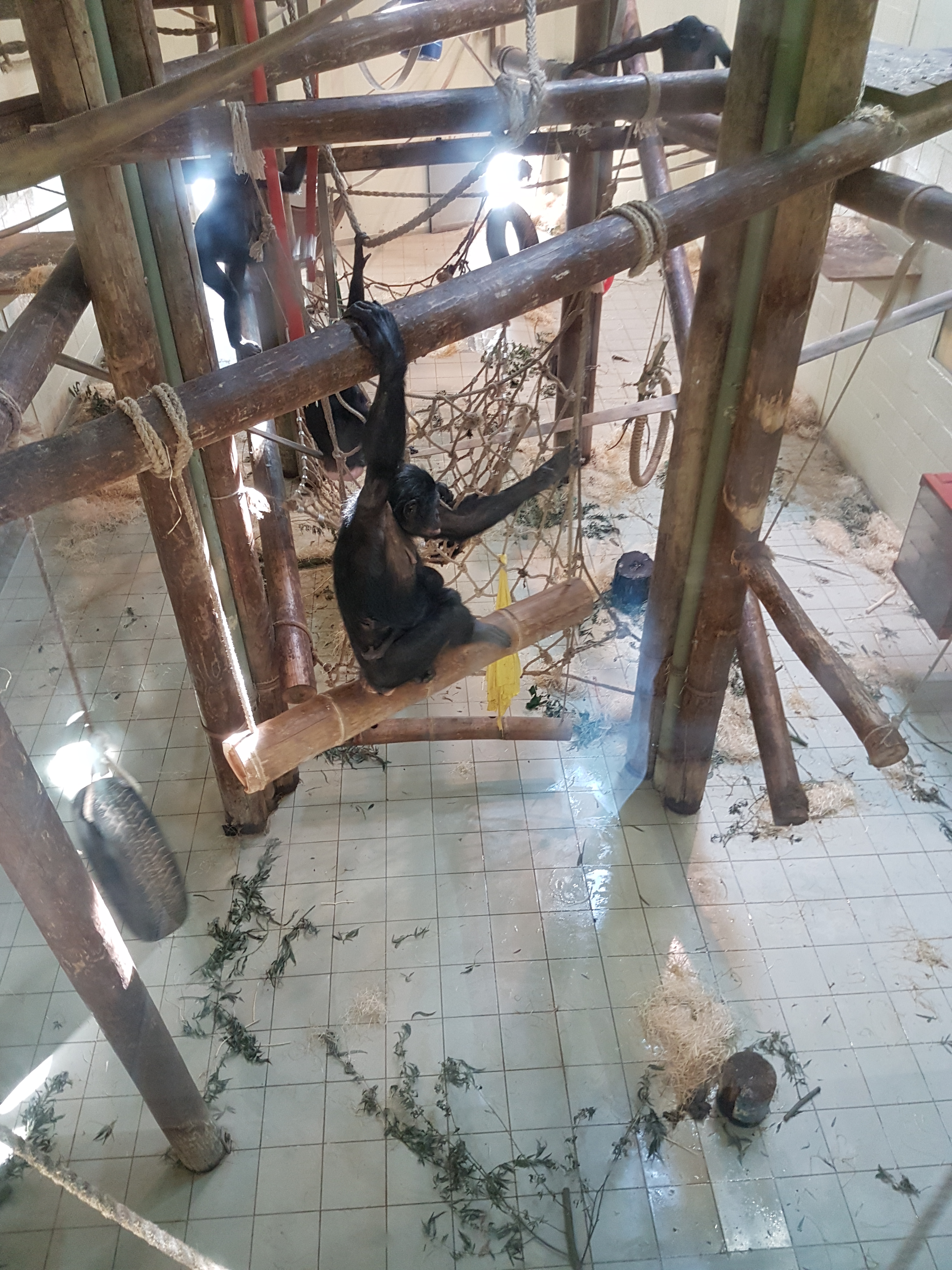
“The AAH is Primarily a Biological Theory”
Verhaegen emphasizes that the Aquatic Ape Hypothesis primarily is a biological theory, and not an archaeological theory. “Our bodies hold the key to our evolutionary background,” Verhaegen said. “That give us much better evidence than the fossils.” As a doctor, Verhaegen has a great anatomical and biological understanding of the human body, and from this perspective it is not strange that many doctors have been supporting the Aquatic Ape Hypothesis throughout the years. On the top of that, Verhaegen is also a great theorist and he is breaking new grounds in the development of the AAH. Unfortunately, many of Verhaegen’s theories are challenged, not only by critics of the AAH, but also of its proponents who insist on a “lighter” version of the theory. For example, the idea that Homo erectus or close relatives thereof were shallow-water divers, and that frequent wading and walking came later during the Pleistocene in our evolution, is still hard to accept for some proponents, even though significant archaeological and other data point in this direction. Verhaegen argues that several littoral adaptations only appeared in Homo erectus, not only a very heavy skeleton, but for instance also a low long flat skull, drastic brain expansion (arguably due to consumption of abundant brain-specific nutrients in shellfish etc.), an external nose, ear exostoses due to exposure to cold water, dorso-ventrally flattened thigh-bones (femora), intercontinental dispersal (including colonization of islands such as Flores, Sulawesi, Crete), traces of shellfish consumption and human-made engravings on shells, etc.
Wide Acceptance of Aquatic Life of Homo sapiens – but not of our Forebears
Today, the wider scientific community accept the fact that early Homo sapiens was often living close to seashore. The findings of 125,000-year-old tools in a former coral reef in Eritrea was published in Nature and reached the front page, and recent older findings, for instance, in the Pinnacle Point in South Africa has also got similar attention – and approval. However, most traditional paleoanthropologists will not admit that these people had evolved in an aquatic environment. They choose to see these adaptations as a colonization of one of many environments humans were living in, rather than an early evolutionary adaptation to an aquatic environment.
But why stop with Homo sapiens? Why doesn’t the community also accept aquatic adaptations in for example Homo erectus and other archaic-looking Homo species as for example Neanderthals that perhaps show the clearest signs of an aquatic adaptation? Why is it so difficult to accept these findings? Why do we only accept signs of an aquatic lifestyle after Homo sapiens had already emerged?
The visit in Putte was very pleasant and hospitable. We stayed up till late night in Verhaegen’s office, where he showed me books and publications of earlier conferences, as well as his own drawings of the possible features of Homo erectus. “I hope that the Aquatic Ape Hypothesis will get widely accepted before I pass away,” Verhaegen said. “I have been waiting for a shift for many years, but until now I haven’t seen any greater improvement. As a matter of fact, I am still amazed that the paleoanthropological community doesn’t accept the theory.”
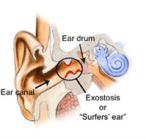 M. Cameron in their article “Surfer’s Ear (Aural Exostoses) Provides Hard Evidence of Man’s Aquatic Past” in 2014 in which they show that aural exostoses have been found not only in old Homo Sapiens fossils but also in Homo Erectus and Homo Neanderthalensis fossils. Surfer’s ear is a bone growth in the ear canal that protects the eardrum from pressure, which is proportional to the time spent in cold water. The bone growth has been found in fossils stretching as far away as South Africa, the Mediterranean and Australia. According to Rhys-Evans this bone growth can only be explained by extensive swimming in cold water.
 that does not go hand in hand with the idea of development. Hence, by strengthening the waterside theory, the proponents of the theory just make it more inappropriate in the anthropological community. That’s why they compare the theory with the mythological hydra: if you cut off one head, two new ones grow out.
 ervatism in the tool making traditions as for example Oldowan stretching from 2.6 million years BP to 1.7 million years BP, Acheulean stretching from 1.76 million years BP to 100 thousand years BP and Middle Stone Age (MSA) starting around 280,000 years ago and ended around 50–25,000 years ago have been extremely conservative over hundreds of thousands of years. Where were all the innovations? And why did the early group of Homo Sapiens that made it all the way to Israel around 130 – 85 thousand years ago not out conquer the Neandertals? Why were the same caves inhabited alternately by both Homo Sapiens and Neanderthals before Homo Sapiens finally disappeared from the area?
 potential, but not utilized. It evolved, but as the other side of the coin. The main function of the growing brain was rather to repeat earlier invented behaviour, not to start the day by coming up with an ingenious idea about luring a big prey. We also must keep in mind that tool management and language are located in the same part of the brain and closely related to each other. Hence, the function of this part of the brain was to cement behaviour and movements, to master the art of reappearance. But when the humans had to leave their tropical environment because of climate change – as in South Africa approximately 100 000 years ago – this language lost its grip and turned creative. In other words, maybe the brain in its essence is anti-development. That, I am sure, will be the paradigm of tomorrow.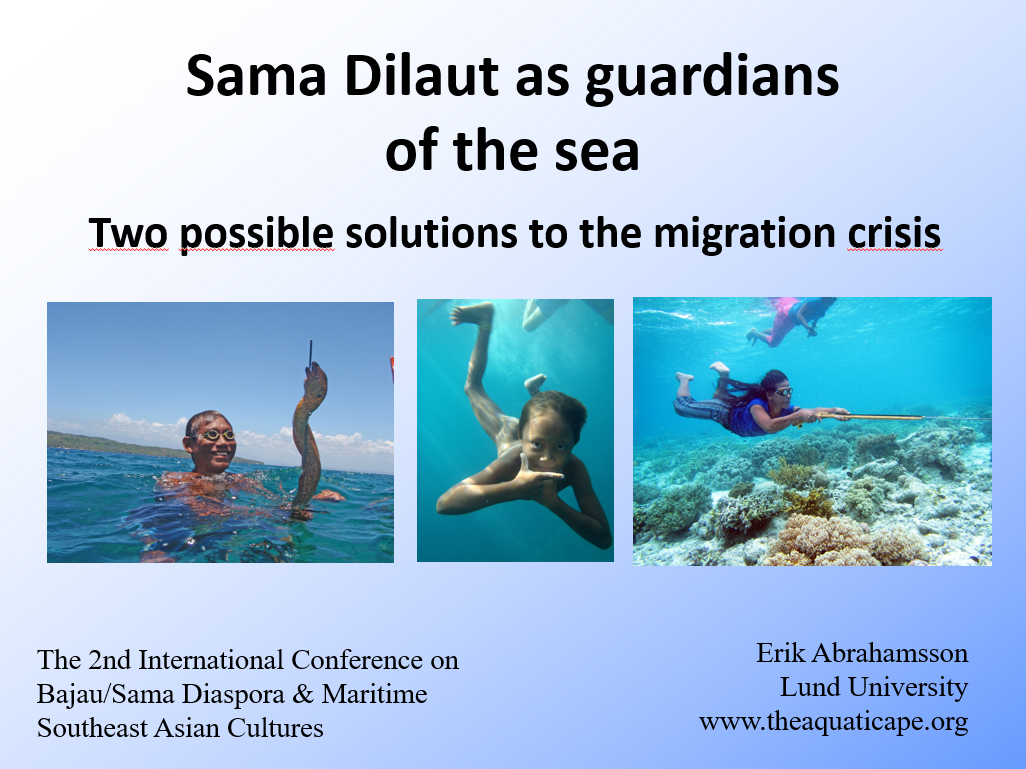


 Phook about Sama Dilaut as PDF:
  ion conference in London in 2013. He has a great interest in the Aquatic Ape Theory and has made two very informative posters on the matter, after carefully have studied the work of scientists in the field. In two intense days, we discussed different aspects of the theory, as for example it’s health implications and the emergence of speech. We also discussed how we can promote the theory among a larger audience.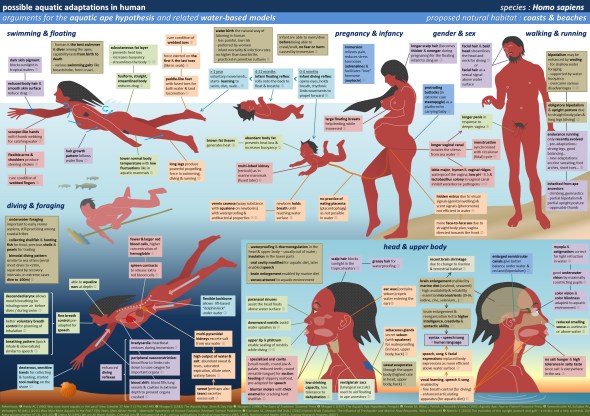
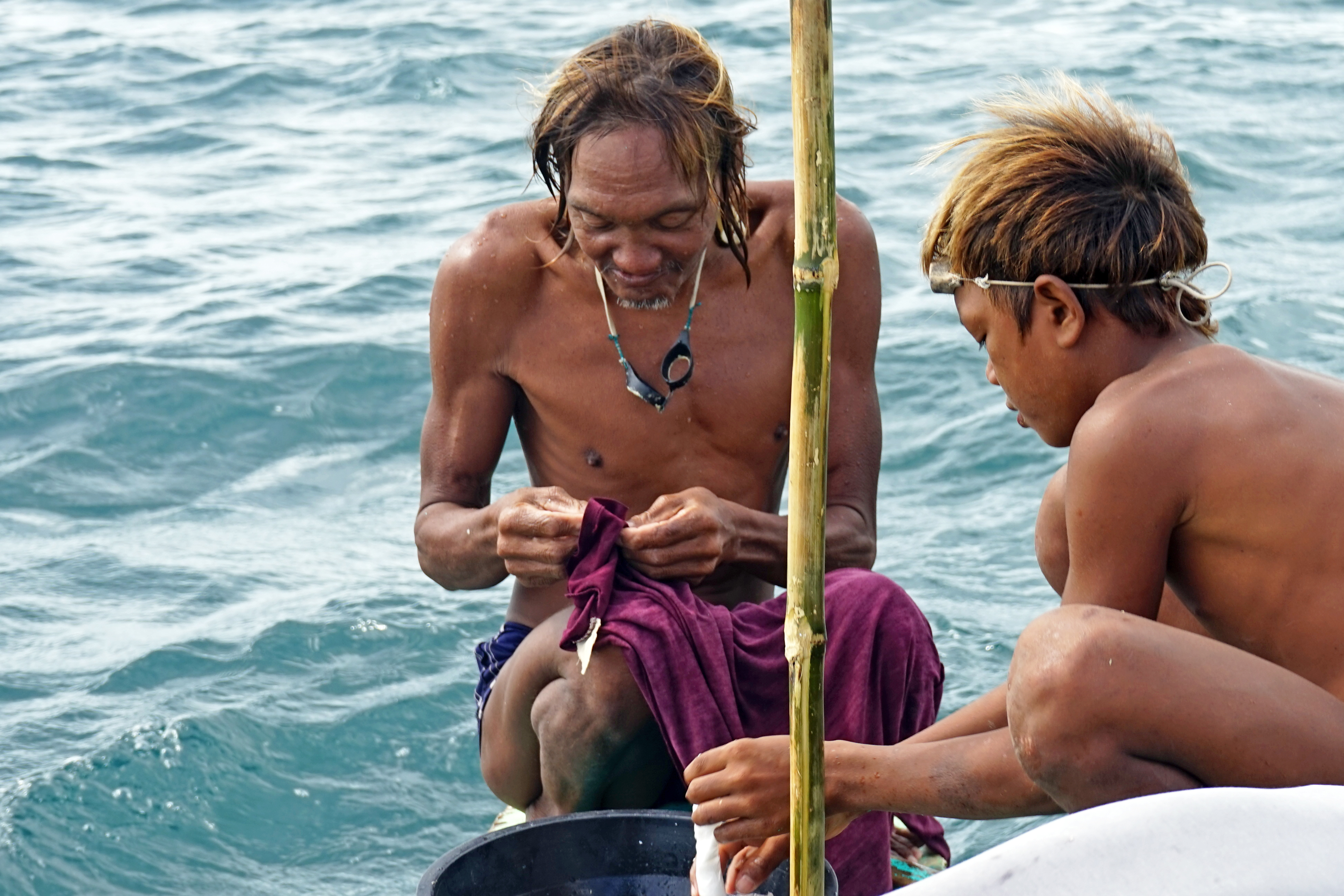


 e that he had just come back from seasonal work in Kota Kinabalu. Hence, also the most skilled fishermen might choose to make a living in the job market rather than make their own fishing trips in the region!
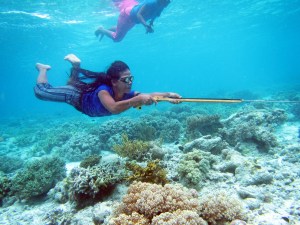 e South Seas” and the movie “The Mirror Never Lies”. During our stay in the village, we joined a group of women spearfishing, and it was fascinating to see their acquaintance with the ocean. We also followed fishing with Tadi, a 70-year-old fisherman who is still an incredible fisherman. He was the most successful fisherman during our trips, outperforming much younger spear gun fishermen. We also got the opportunity to measure Tadi’s spleen, and it turned out that his spleen is much bigger than peoples at the same age and with the same body size, and whom do not make a living from diving. The spleen is a very critical organ for experienced divers, since it consists of a high concentration of blood cells that can be released under pressure.
 trip at sea lasting for a few days. We stayed two nights at sea, collecting shell fish and spear-gunned fish. Among those who followed were 17 year old Muspang, the youngest boy in BBC:s movie with Tanya Streeter He is already a father and a great diver. However, I was more impressed by his mother, the same woman that was highlighted in Svea Andersson’s movie. Again pregnant, she was diving up to eight meters in search for shell fish and clams, as well as spear gun fishing. She is one of the last free diving Sama women with great diving abilities; one of the few remaining in not only Kabalutan but most likely in most Sama communities throughout Southeast Asia.