
In a 2016 September BBC radio program titled “The Waterside Ape”, Sir David Attenbourough presents new evidence for the waterside theory that have been published in recent years. In the program, they interview free diver Sara Campell who went from a total beginner to a holder of three world records in just eight months, Erika Schagatay who have studied Japanese Ama divers and Bajau divers and compared the data with semi-aquatic mammals and Curtis W. Marean who has discovered dependence on mussels and sea-snails among Homo Sapiens at Pinnacle Point in South Africa at 164 k years ago.
Surfer’s Ear Hard Evidence for the Waterside Hypothesis
A particularly interesting evidence has been formulated by P.H Rhys-Evans and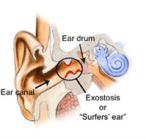 M. Cameron in their article “Surfer’s Ear (Aural Exostoses) Provides Hard Evidence of Man’s Aquatic Past” in 2014 in which they show that aural exostoses have been found not only in old Homo Sapiens fossils but also in Homo Erectus and Homo Neanderthalensis fossils. Surfer’s ear is a bone growth in the ear canal that protects the eardrum from pressure, which is proportional to the time spent in cold water. The bone growth has been found in fossils stretching as far away as South Africa, the Mediterranean and Australia. According to Rhys-Evans this bone growth can only be explained by extensive swimming in cold water.
Critical Response in The Conversation
After the program was released, critics Alice Roberts (Professor of Public Engagement in Science, University of Birmingham) and Mark Maslin (Professor of Paleoclimatology, UCL) wrote a reply in The Conversation with the title “Sorry David Attenborough, we didn’t evolve from ‘aquatic apes’ – here’s why”. In the article, they claim that many of the adaptations that are suitable for an aquatic environment, as for example hairlessness and increased body fat can be explained by a need of cooling down and sexual selection. They also claim that many of our aquatic adaptations evolved on different occasions throughout human evolution, why water cannot be the explanation. Bipedalism, for example, emerged about 6-7 million years ago while our brain started to enlarge about 2 million years ago. They also highlight the flexibility of human behaviour, and they explain later water adaptations as for example the one mentioned in the Pinnacle Point starting at 164 000 years ago, as behavioural adaptability rather than as an inherited way of life.
But why rely on sexual selection? What is attractive in generally what is viable in terms of survival. Hence, if humans started to like hairless bodies and more fatty breasts, it was rather because these characteristics were evolutionary useful, not only that they were considered beautiful. And is it really a problem that different characteristics have evolved on different occasions? The increase of brain size in Homo Erectus is probably much linked to the emergence of deep water Rift lakes that enabled increased feeding from aquatic resources. Hence, the aquatic phase in human evolution was not something that just took place many millions ago right after we left the trees, it has been influencing our evolution till the very emergence of Homo Sapiens.
Misleading and Deep-rooted Criticism against “Pseudo-science” and lack of Fossil Evidence
Bluntly, Roberts and Maslin also criticise the theory for being “pseudo-science” as is does not make any falsifiable predictions, of course irritating many of the researchers outside the area of palaeoanthropology who respectively have found strong evidence for an aquatic past in the fields of for example human physiology, obstetrics and otorhinolaryngology. In a falsifiable experiment, it has also been shown that vernix caseosa, the white substance found coating the skin of new-born human babies is likely to be an adaptation to entering water soon after being born. Further, obviously without listening carefully to the BBC program, Roberts and Maslin also claim that there is no fossil evidence to support the waterside hypothesis even after the discovery of surfer’s ear in Homo Erectus, as well as predation and preparation of very large catfish in Turkana basin at two million years ago, and the fact that literally all well-known fossils as Lucy and Selam have been found in river sediments. Lucy was found next to fossilised crocodile and turtle eggs.
Some of the researchers who participated in the program responded to the criticism from Roberts and Maslin here: A reply to Alice Roberts and Mark Maslin: Our ancestors may indeed have evolved at the shoreline – and here is why…
The Scientific Evolutionary Story of Man is Closely Related to our Belief in Development and Constant Growth
It is sad that the Aquatic Ape/Waterside theory since long has been misunderstood and rejected without further thought. This is also being reflected in other books and magazines dealing with human evolution. Mostly, the savannah or mosaic theory are taken for granted, and forms a basis for further reasoning. This is also the case with the great selling author Yuval Noah Harari, who has written the books Homo Sapiens and Homo Deus. When he talks about our evolutionary past he always relates to the savannah, even though there no longer is any savanna theory out there. Hence, many scholars adapt to the paradigm set by the paleoanthropologists, but which is false. We also have to keep in mind that the concept of human evolution is closely connected to our belief in development and growth. The generally accepted evolutionary story of Homo Sapiens is in fact the scientific creation myth of man, and it repeatedly depicts a human ancestor who were living in a diverse mosaic environment always eager to adapt to new circumstances using an emerging intellect and creativity, and not it’s bodily functions. There is thus a red thread between myth of human evolution and today’s pursuit of constant growth.
The Waterside Theory Requires Another Story of Human Evolution
But the aquatic ape theory tells us another story: here most human characteristics can be explained in relation to a specific biotope: the waterside. However, this idea can’t be accepted by the paleo anthropologists because It implies another creation myth that does not go hand in hand with the idea of development. Hence, by strengthening the waterside theory, the proponents of the theory just make it more inappropriate in the anthropological community. That’s why they compare the theory with the mythological hydra: if you cut off one head, two new ones grow out.
The only solution to this dilemma is to accept the fact that humans during evolution were nothing special. We were not the masterpiece of creation. We were just one animal among others. We ate shellfish that we collected in low tide or by diving. We were walking, wading and swimming long distances along the shore lines. We gave birth to the children in water. And, most importantly, we were not creative engineers, who always came up with new ideas for survival. There was no need for constant invention – because their world was never changing as rapidly it does today. What was important to our ancestors was to learn the techniques of survival that were already in use. What was important to our ancestors was to learn the techniques that were already in use, ranging from tool manufacturing, motor skills and resource utilization. They also inherited a profound knowledge about edible plants and marine resources. As a matter of fact, if we look at the tools used by our human forefathers we can see that they were made in nearly identical ways over long periods of time. The stability and the cons ervatism in the tool making traditions as for example Oldowan stretching from 2.6 million years BP to 1.7 million years BP, Acheulean stretching from 1.76 million years BP to 100 thousand years BP and Middle Stone Age (MSA) starting around 280,000 years ago and ended around 50–25,000 years ago have been extremely conservative over hundreds of thousands of years. Where were all the innovations? And why did the early group of Homo Sapiens that made it all the way to Israel around 130 – 85 thousand years ago not out conquer the Neandertals? Why were the same caves inhabited alternately by both Homo Sapiens and Neanderthals before Homo Sapiens finally disappeared from the area?
In fact, what distinguished man throughout history was rather an extremely precise handwork, a strict repetition of long series of complex hand movements; or in other words: a repetition of already acquired technology. And not a constant flow of inventions and change.
A New Paradigm Which is not Based on the Idea of Development is Required
We must accept a new paradigm – that humans were not ingenious creators but rather extremely skilled imitators – and I am convinced that this paradigm will grow in popularity when we fully realise the destructive impact humanity and rationality have on this earth. Soon, the believe in development will not lay the foundation of the scientific creation story of man.
But then, what happened? Why did Homo Sapiens finally change and start to migrate to the most diverse environments? Yuval Noah Harari talks about a cognitive revolution that took place approximately 70 000 years ago enabling us to organize people on a larger scale in relation to a common shared world view. The revolution also led us to manufacture more advanced tools, create more diverse art and hunt on a large scale. Yuval Noah Harari argues that changes in our DNA enabled this change. Again, we can see the strong faith in the connection with human evolution and today’s growth, and the conviction that today’s humans reflects the inner core of our DNA. In other words, the paradigm assumes that we are meant to be geniuses.
But can small changes in brain make that difference? And if so, what was the purpose of our large brains that we had as early as 200 000 years ago despite not creating any visible inventions?
We Must Rethink our Brain and Language
There is, as I see it, only one possible answer to this dilemma. The creative capacity of man throughout most of our evolution was latent. It was a part of our brain and  potential, but not utilized. It evolved, but as the other side of the coin. The main function of the growing brain was rather to repeat earlier invented behaviour, not to start the day by coming up with an ingenious idea about luring a big prey. We also must keep in mind that tool management and language are located in the same part of the brain and closely related to each other. Hence, the function of this part of the brain was to cement behaviour and movements, to master the art of reappearance. But when the humans had to leave their tropical environment because of climate change – as in South Africa approximately 100 000 years ago – this language lost its grip and turned creative. In other words, maybe the brain in its essence is anti-development. That, I am sure, will be the paradigm of tomorrow.


 Phook about Sama Dilaut as PDF:
 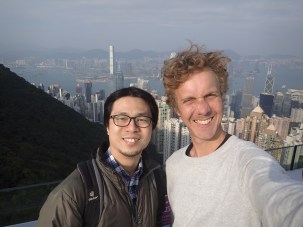 ion conference in London in 2013. He has a great interest in the Aquatic Ape Theory and has made two very informative posters on the matter, after carefully have studied the work of scientists in the field. In two intense days, we discussed different aspects of the theory, as for example it’s health implications and the emergence of speech. We also discussed how we can promote the theory among a larger audience.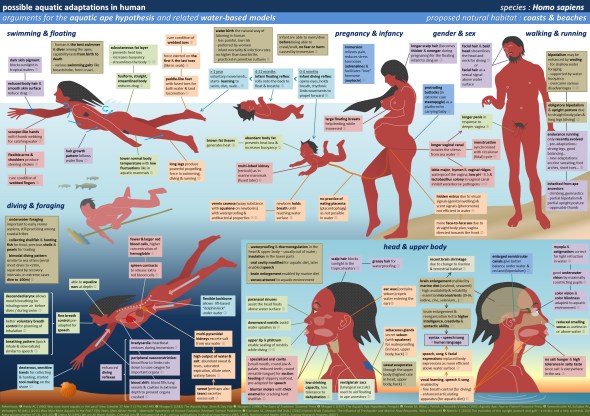
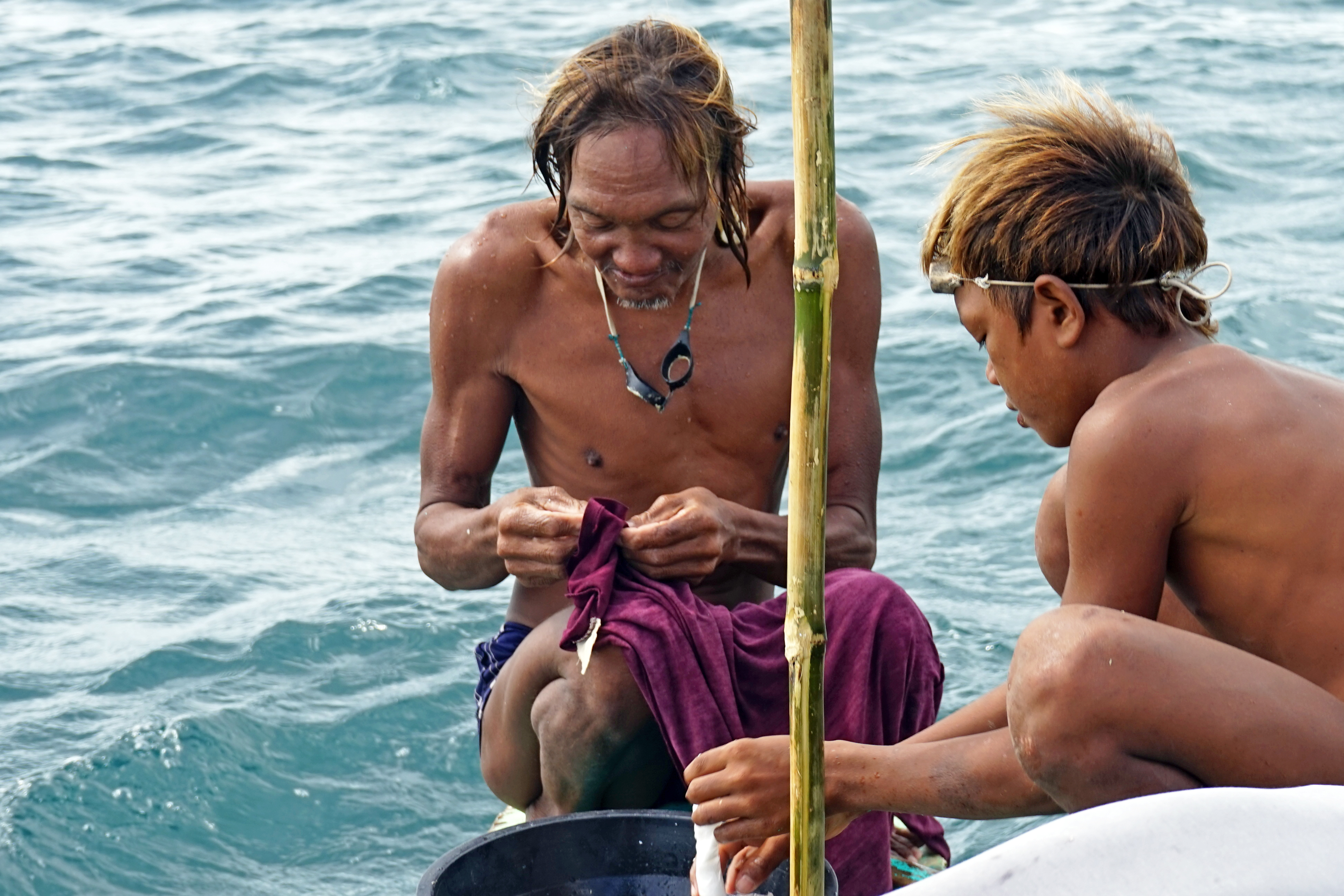


 e that he had just come back from seasonal work in Kota Kinabalu. Hence, also the most skilled fishermen might choose to make a living in the job market rather than make their own fishing trips in the region!
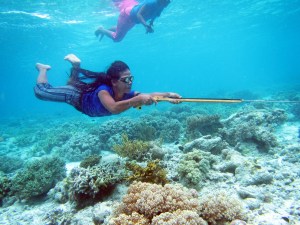 e South Seas” and the movie “The Mirror Never Lies”. During our stay in the village, we joined a group of women spearfishing, and it was fascinating to see their acquaintance with the ocean. We also followed fishing with Tadi, a 70-year-old fisherman who is still an incredible fisherman. He was the most successful fisherman during our trips, outperforming much younger spear gun fishermen. We also got the opportunity to measure Tadi’s spleen, and it turned out that his spleen is much bigger than peoples at the same age and with the same body size, and whom do not make a living from diving. The spleen is a very critical organ for experienced divers, since it consists of a high concentration of blood cells that can be released under pressure.
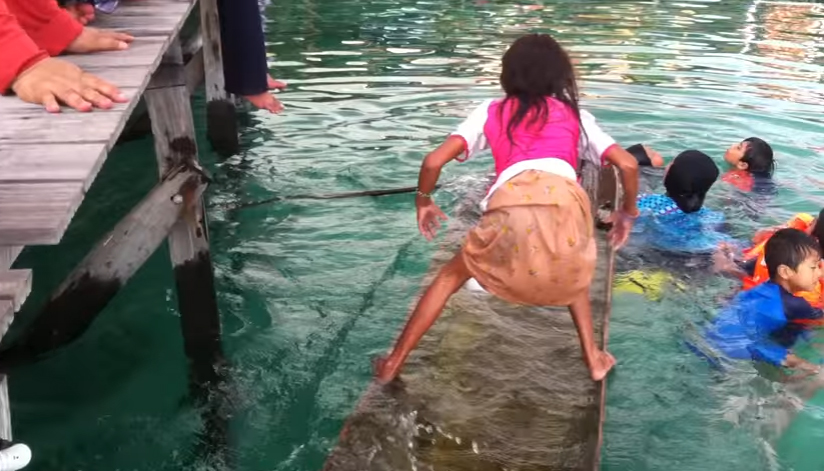
 trip at sea lasting for a few days. We stayed two nights at sea, collecting shell fish and spear-gunned fish. Among those who followed were 17 year old Muspang, the youngest boy in BBC:s movie with Tanya Streeter He is already a father and a great diver. However, I was more impressed by his mother, the same woman that was highlighted in Svea Andersson’s movie. Again pregnant, she was diving up to eight meters in search for shell fish and clams, as well as spear gun fishing. She is one of the last free diving Sama women with great diving abilities; one of the few remaining in not only Kabalutan but most likely in most Sama communities throughout Southeast Asia.




 The Aquatic Ape