
Shifting the Paradigm: From Acheulean Hand Axes to Modern Minds
The prevailing paradigm in paleoanthropology asserts that we developed larger brains to manage and adapt to a wide range of environments and challenges. Our cognitive flexibility is thought to have evolved so that we could think abstractly, plan ahead, solve complex problems, and adjust our behavior to changing circumstances. This paradigm places the human brain and language at the center of evolution, suggesting that these capabilities enabled survival in a mosaic of environments (Klein, 2009; Tattersall, 2012).
However, the fossil record contradicts this perspective. Homo erectus lived from approximately 1.9 million years ago to around 110,000 years ago (Anton, 2003). During this extensive period, their brain volume nearly doubled, from about 600 cubic centimeters to approximately 1,000 cubic centimeters (Rightmire, 2004). Despite this significant increase in brain size over more than a million years, they continued to produce Acheulean hand axes with only minor variations and lived in warmer climates (Lycett & von Cramon-Taubadel, 2008). Tools can be seen as fossilized behavior – if the tools remained stable, it is likely that the behavior was also stable. Even early Homo sapiens, Neanderthals, and our common ancestor Homo heidelbergensis exhibited extreme conservatism in their behavior.
This raises the question: if the brain evolved to be flexible, why is this not reflected in the fossil record? One might also wonder why humans would evolve in constantly changing environments while other animals evolved to thrive in specific niches with stable survival strategies, sometimes displaying complex behaviors. Mammals such as bears and orcas live in relatively stable environments and exhibit intricate behaviors, contrasting with the portrayal of human evolution as being driven by constant environmental changes. Perhaps the idea of a perpetually changing environment is a misconception – a projection of modern man’s idolized flexible nature onto the process of evolution.
The Necessity of Stability for Evolutionary Change
Evolution requires stability. If a body part evolves, it signifies consistent behavior and selection pressure over generations. If the brain evolved to enhance flexibility and creativity, it implies that these humans lived in constantly changing environments and had to be inventive day after day. This contradicts the evolution of other body parts, which require stability over generations, as consistent selection pressure is necessary for body parts to be selected and changed. During the same period that Homo erectus developed a gradually larger brain over millennia, they also grew taller, became more robust, appeared to lose body hair, and developed a wider pelvis, among other changes (Tattersall, 2012).
Within the paleoanthropological paradigm, several of the human body’s physical characteristics have been considered of secondary importance. Anthropologists have primarily focused on how and why we stood on two legs and freed our hands, as well as explaining why we became hairless, which is considered important for thermoregulation—both traits seen as prerequisites for living in various environments (Klein, 2009).
Specific traits that were not considered to have direct survival value, such as women’s round breasts, lips, and body aesthetics, have often been explained by male attraction. This has led to a sexualization of human evolution, as Elaine Morgan insightfully demonstrated (Morgan, 1997).
Thus, anthropologists have been predominantly interested in brain development and have primarily focused on physical traits that enabled flexible behavior. This, in essence, encapsulates the current paradigm.
An Anomaly Foretelling a Paradigm Shift: The Aquatic Ape Theory
The Aquatic Ape Theory (AAT) cannot be accepted under the current paradigm of human evolution. The more arguments presented in its favor, the more it is ridiculed and marginalized. It has been likened to a hydra; when one head is cut off, two more grow back. As an anomaly, it has been treated with anger, ridicule, and denial, as I discussed in my Bachelor thesis from 2008. The Aquatic Ape Theory contradicts our current framework, where human development is viewed through the lens of adaptability and thriving in various environments. The prevailing paradigm focuses on understanding human evolution by studying when we became bipedal and freed our hands, as well as how we adapted to new dietary and climatic challenges.
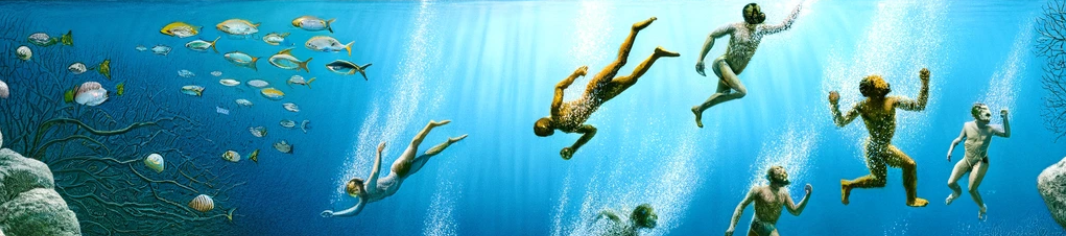
The Aquatic Ape Theory helps explain a range of physical characteristics in humans that have previously been of little interest in anthropology. It explains why we have prominent lips, round breasts, hairlessness, streamlined hair growth, the diving response, sensitive fingertips, and the phenomenon of surfer’s ear. (Morgan, 1997; Verhaegen, 2013).
Our prominent lips can be seen as an adaptation for creating a seal while sucking liquids and food in a watery environment. Women’s round breasts may have developed to facilitate nursing in water, where the child may need to grasp the breast differently than on land. Human hairlessness could be an adaptation to reduce drag while swimming. The remaining body hair, such as on the head, is directed backward, which reduces water resistance.
The human diving response, which includes a reduced heart rate and decreased blood circulation to the extremities when submerged in water, is similar to that of marine mammals and supports the hypothesis of a water-based adaptation. Our sensitive fingertips may have developed to better feel and handle food and objects in a wet environment. The phenomenon of surfer’s ear, or exostoses in the ear canal, occurs more frequently in people who are regularly exposed to cold water, which could indicate an evolutionary adaptation to aquatic life.
These physical traits, previously seen as irrelevant or difficult to explain within the traditional paradigm of paleoanthropology, find a logical explanation through the Aquatic Ape Theory. This theory suggests that our ancestors spent a significant part of their lives in or near aquatic environments, which has shaped many of our unique physical characteristics (Morgan, 1997; Hardy, 1960; Verhaegen, 2013).
Both the fossil record, with its extremely conservative behavior observed in Homo erectus, Homo heidelbergensis, Neanderthals, and early Homo sapiens, and several of our physical traits receive a more plausible explanation when we envision a semi-aquatic past. As anomalies continue to accumulate within the current paradigm, in line with Kuhn’s theory, it becomes increasingly evident that a paradigm shift is imminent.
The Paradigm Shift
The copernican revolution, which I have previously written about, paves the way for the Aquatic Ape Theory by emphasizing bodily adaptations through evolution and highlighting the brain as an assistant to the body rather than a constant innovator. It is only through this fundamental shift that we can explain the fossil record over the past millions of years and fully understand our physical characteristics.
Our brains did not primarily evolve to make us continuously smarter and more innovative. On the contrary, their primary function was to stabilize our behavior, cement routines, and enhance our ability to imitate and emulate. This stability in behavior and technology enabled survival and adaptation over generations, rather than driving constant innovation.
The Role of Tools in Human Evolution: From Stability to Innovation

Tools have played a central role in human evolution. A hand axe, for example, represents an extension of the hand, equipped with a sharp cutting edge of stone. Tools can be considered exosomatic (external) organs that allow us to extract energy from environments that would otherwise be inaccessible. Tools enable us to adapt to environments where our bodies alone would fall short. Essentially, tools served as a bridge between our biological capabilities and the demands of new environments, acting like a lifeline that enabled adaptations which would otherwise be biologically impossible.
Once humans began using tools to survive in environments they were not biologically adapted to, evolution quickly and selectively adapted our bodies to these new surroundings. Throughout human history, this process involved adapting our bodies, behaviors, and the transmission of knowledge to new environments to become as efficient as possible in copying and imitating survival strategies. Working memory, perception, and especially language evolved and were refined to effectively replicate these behaviors. However, language should not be understood in the same way we relate to it today; rather, it was a stabilizing structure that linked humans to both their environment and each other. One could say that language functioned as if it were a biological trait due to its conservative nature. This explains the co-evolution of both brain and bodily adaptations, something the current paradigm struggles to comprehend.
The creative potential and power of language developed as latent abilities—they were the other side of the coin, the hidden force. During events of climate change, when the previously well-established survival strategy was no longer effective, language was reprogrammed, awakened, and became free and untamed. This led to technological innovations and adaptations. However, these innovations were only temporary until a new adaptive strategy emerged—since changes in nature do not occur indefinitely—after which stability and consistency were restored. This pattern applies to the transition from one human species to another.
For instance, Homo heidelbergensis appeared quite suddenly in the fossil record, with no clear intermediate forms linking them to their predecessors, suggesting a rapid evolution from earlier hominins (Rightmire, 1996). Similarly, Homo erectus emerged without evident transitional fossils, indicating a swift development from earlier species (Antón, 2003). This rapid emergence of new species can be explained by selective adaptation to specific environments, driven by the rapid explosion of creativity and intelligence. We developed new techniques that allowed us to adapt to new environments and find stable survival strategies. This stability, in turn, created strong selection pressure and led to evolution in a particular direction.
Final Reflections: The Hubris of Man
Homo erectus lived on earth for nearly 1.9 million years. Throughout this entire period, one tool was their most constant companion: the Acheulean hand axe.

With this tool, a seemingly simple yet enduringly effective invention, humans were able to survive in environments they were not biologically adapted to. Most likely, the stone axe was used to open shellfish, such as mussels and clams, which would otherwise have been inaccessible to humans (Morgan 2019). As Marc Verhaegen has suggested, Homo erectus became increasingly adept at exploiting the resources of the sea and lakes over time, refining and perfecting this survival strategy.
This insight sheds new light on who we are today. During the cognitive revolution, our language came alive, and we immediately sought new survival strategies. This also helps explain Alfred Wallace’s conundrum, as he argued that humans are mentally over-equipped for the kind of life they lead. Here we are, dreaming of moving to Mars and creating artificial general intelligence (AGI) and striving to reach a singularity, when what we should be striving for is to find and reproduce a long-term adaptive strategy, just as our ancestors did.
Before colonialism, there were groups of people who had lived stably for tens of thousands of years without actively reshaping nature through the domestication of plants and animals, such as the Kung people and Australian Aboriginals. Unfortunately, rationality and intelligence have taken over and led us astray. This is the hubris of man: to believe that endless innovation is the key to survival, when in reality, we might just end up being the species that perfected the art of self-destruction.
Literature
Antón, S. C. (2003). “Natural History of Homo erectus”. American Journal of Physical Anthropology, 122(S37), 126-170.
Hardy, A. (1960). “Was Man More Aquatic in the Past?”. New Scientist, 7(1), 642-645.
Klein, R. G. (2009). The Human Career: Human Biological and Cultural Origins. University of Chicago Press.
Lycett, S. J., & von Cramon-Taubadel, N. (2008). “Acheulean variability and hominin dispersals: a model-bound approach”. Journal of Archaeological Science, 35(3), 553-562.
Morgan, E. (1997). The Aquatic Ape Hypothesis. Souvenir Press.
Morgan, G. F. (2019). The Acheulean Hand Axe: A Toolmaker’s Perspective. Academia.edu.
Rightmire, G. P. (1996). “The Human Career: Human Biological and Cultural Origins”. University of Chicago Press.
Rightmire, G. P. (2004). “Brain size and encephalization in early to Mid-Pleistocene Homo”. American Journal of Physical Anthropology, 124(2), 109-123.
Tattersall, I. (2012). Masters of the Planet: The Search for Our Human Origins. Macmillan.
Verhaegen, M. (2013). “The Aquatic Ape Evolves: Common Misconceptions and Unproven Assumptions about the so-called Aquatic Ape Hypothesis”. Human Evolution, 28(3), 237-266.
Verhaegen, M. (2013). “The Aquatic Ape Hypothesis: Ten Years After”. Anthropological Review, 76(1), 1-17.


 The Aquatic Ape
This article makes some excellent points in supporting the Aquatic Theory, however it begins with a preconceived notion that is commonly employed to undermine the theory: the assumption that the fossils paleontologists have found must have come from our ancestors; or, if these individuals were not our ancestors, those who were our ancestors must have been exactly like these folks. Thus you ask: “if the brain evolved to be flexible, why is this not reflected in the fossil record?” The answer to this question is quite simple: the dry land fossil record reveals the individuals who died out, without producing descendents, because they lacked the Omega-3 fatty acids to expand and complicate their brains. Those who lived beside the sea innovated and evolved, but their fossils and their advanced stone tools were washed away and destroyed by a million years of seaside storms and savage winds; furthermore, Jon Erlandson says “the record of Pleistocene marine and freshwater fishing was fundamentally biased by global sea level rise of ~120 m between 20,000 and 6000 years ago which flooded the shorelines and nearshore lowlands where Pleistocene coastal populations would have lived” (page 125 in chapter 7 in Human Brain Evolution, edited by Stephen Cunnane and Kathlyn Stewart, published in 2010).
As you say “The Aquatic Ape Theory (AAT) cannot be accepted under the current paradigm of human evolution” because the “current paradigm of human evolution” relies on fossils found on dry inland. To discover the traces of our evolution, we must do as you do so well in this article, examining our own bodies which clearly show our evolution in an aquatic environment with a constant supply of Omega-3 fatty acids, iodine, selenium, and nutrients in seaweed, shellfish, and fin fish. While I cannot suggest we cannot change the name for this theory from “aquatic ape theory” to the “aquatic nutrition theory,” we can make Elaine Morgan’s magnificent contribution even more powerful by combining it with the nutritional research of Michael Crawford and his followers, as shown in the Preface, Introduction, eleven chapters, and a thousand or so references in Human Brain Evolution.
Jeff Robbins
June 10, 2024 at 4:43 am
Hi Jeff,
Thank you for your thoughtful comment and for engaging with the topic. I appreciate your points and would like to address them in detail.
Firstly, it’s true that many archaeological traces of coastal populations are submerged due to rising sea levels since the Pleistocene epoch. As Jon Erlandson has noted, sea level rise has indeed biased our understanding of coastal and marine adaptations, complicating the fossil record and making it challenging to find direct evidence of these early coastal populations.
However, it’s also important to note significant discoveries, such as the 125,000-year-old stone tools similar to Acheulean hand axes found on an emerged reef terrace in the Red Sea at Abdur Reef Limestone, Eritrea (Walter et al., 2000). These findings suggest that some coastal populations did leave behind durable traces that survived the test of time, indicating that coastal living was not only feasible but perhaps a well-established way of life for some early human populations. Additionally, early humans living in coastal populations were likely more traditional than others, as evidenced by the continued use of hand axes in Africa 125,000 years ago, long after they had become rare in other regions.
Regarding the current paradigm in paleoanthropology, my point is that it emphasizes adaptations in various environments (man as a specialized generalist), overlooking the potential for a semi-aquatic phase in human evolution. An aspect of this greater paradigm is that researchers often focus too narrowly on finding “missing links” in the fossil record, rather than examining the evidence provided by our own bodies, which clearly show our evolution in an aquatic environment with a constant supply of Omega-3 fatty acids, iodine, selenium, and nutrients from shellfish, etc.
While it is true that many traces are underwater, it is also evident that many human species were incredibly conservative in their early existence. Neanderthals, for example, lived long before the Mousterian tools developed and maintained a stable technological and lifestyle pattern for hundreds of thousands of years. This stability suggests that once effective survival strategies were developed, there was little evolutionary pressure to innovate further (evolution requires stability). In the early stages of all hominin species, their lifestyle was incredibly stable, and invention came later, primarily as a result of changing living conditions, most likely because of climate change that triggered the latent ability for creativity or.
This conservatism aligns well with my proposal for a paradigm shift, which suggests that evolutionary development increases the capacity for imitation rather than invention.
The fundamental paradigm shift we need involves rethinking what brain growth and cognitive development meant for our ancestors. Rather than viewing increased brain size as a direct indicator of modern “smartness,” it may represent enhanced capacities for social learning, imitation, and the maintenance of complex cultural practices. This perspective encourages us to look beyond fossil evidence alone and to consider our physical and biochemical adaptations as crucial indicators of our evolutionary past.
Thank you once again for your valuable insights. I believe that by integrating these perspectives, we can develop a more nuanced understanding of human evolution.
Best regards,
Erik
June 29, 2024 at 11:10 pm