
The Paradigm Shaping Our Understanding of Human Evolution
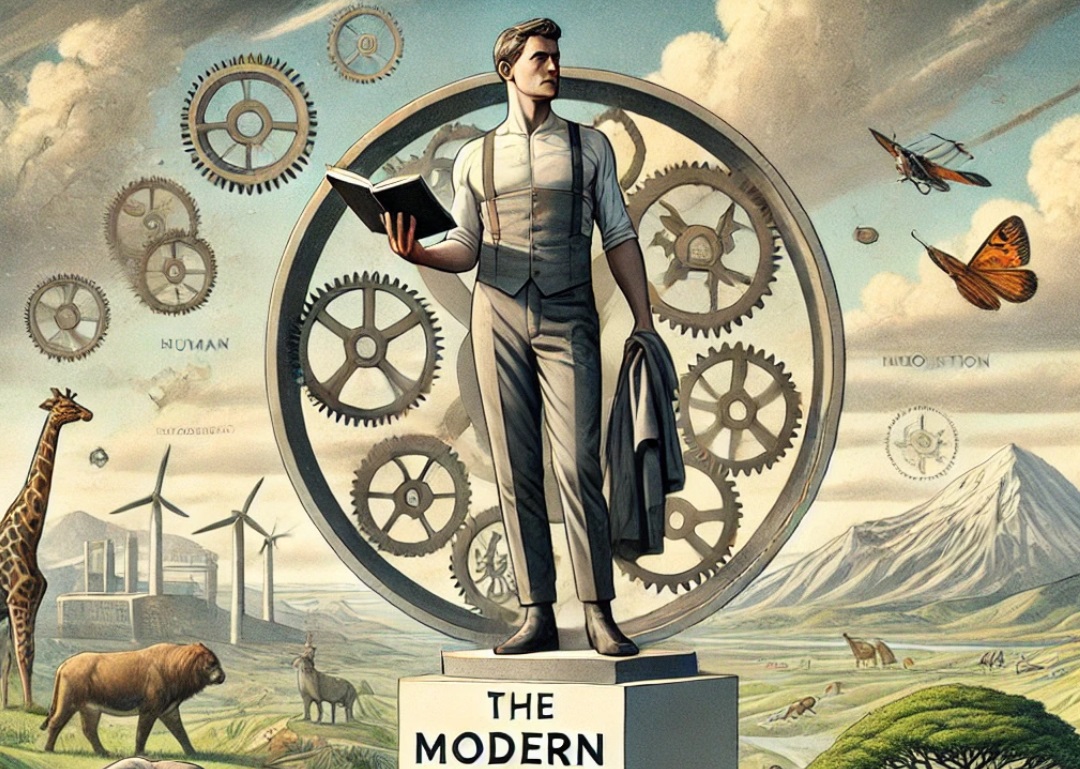
Our understanding of human evolution is not just a scientific endeavor but also a reflection of our self-perception and cultural preconceptions. These elements form part of the underlying paradigm—as discussed by Thomas Kuhn (1962)—or “doxa,” a concept similar to a paradigm introduced by philosopher Pierre Bourdieu (1977), that shapes our understanding of ourselves.
In this context, the theory of evolution, while groundbreaking, has not fundamentally altered our societal structures or self-conception. Instead, it has been adapted to reinforce the cultural and intellectual frameworks that have influenced Western thought for over two millennia, starting from the birth of philosophy.
In our modern, fast-paced culture, we have lost touch with the concept of stability in nature and society. We struggle to imagine a world where multiple generations coexist within the same deep-rooted reality. Our ancestors did not need to be perpetually inventive; rather, their lifestyles were remarkably stable—a fact evidenced by traditional hunter-gatherer societies like the !Kung people (Lee, 1979) and Australian Aboriginals (Tonkinson, 1978). The worldview of these traditional peoples was cyclical rather than linear (Eliade, 1954). In many traditional cultures, humans were regarded as immature and subordinate beings—apprentices to nature, the ultimate teacher (Ingold, 2000). However, over time, this worldview has shifted from being cyclical and holistic to linear, obsessed with the idea of progress and liberation from our natural limitations (Nisbet, 1980).
In previous blog posts, I have discussed the prevailing paradigm in anthropology that emphasizes human intelligence and flexibility, which can make it challenging to consider alternative theories like the aquatic ape theory. In this blog post, we will take a closer look at the deeper perceptions behind the current paradigm of flexible man.
Characteristics of Our Current Paradigm
Our current paradigm is closely intertwined with our views on economic growth and the valorization of entrepreneurship. We project our beliefs about ourselves onto our understanding of evolution, turning it into a form of storytelling. This narrative began with “Man the Hunter” (Lee & DeVore, 1968) and evolved into the “Savannah Hypothesis,” which, after being challenged, transformed into the concept of a mosaic of environments requiring constant flexibility (Potts, 1998). Human intelligence is seen as a trait akin to a lion’s strength or a cheetah’s speed. While animals became faster, more agile, and stronger, humans became smarter. Philosopher Karl Popper summarized this perspective well with his quote: “Our theories die in our place” (Popper, 1963, p. 216).
This paradigm is characterized by deep-seated feelings and assumptions, fundamentally unchanged over centuries—as elaborated by Thomas Kuhn in his concept of paradigms (Kuhn, 1962) and referred to as “doxa” by Bourdieu (1977). This enduring paradigm is not only evident in academic theories but also permeates our literature and cultural narratives. In literature, this perspective is vividly illustrated in Robinson Crusoe (Defoe, 1719), widely regarded as the first modern novel. Stranded alone on a remote island, Crusoe methodically tackles each challenge with resilience and ingenuity, viewing nature as a resource to be mastered. His journey reflects the Enlightenment-era view of man in his authentic state—capable of adapting, solving problems, and exercising rationality to shape his environment (McInelly, 2003). When he meets Friday, Crusoe regards him as a noble savage whom he begins to teach civilized behavior. Eventually, Friday refers to Crusoe as “Master.”
In anthropology, one of the central questions has often been why humans began walking on two legs. This shift to bipedalism was seen as a pivotal development that freed our hands for tool use and allowed for greater flexibility in our behavior (Darwin, 1871). Consequently, much of human evolution has been attributed to our own ingenuity and adaptability, enabling us to become masters of diverse environments.
However, transitioning from quadrupedalism to bipedalism required significant anatomical transformations, particularly in the structure of the knee and pelvis (Lovejoy, 1988). This raises questions about whether the intermediate stages could have been evolutionarily advantageous. Anthropologist Owen Lovejoy suggested that bipedalism arose to enable males to carry food to females, thereby promoting monogamy (Lovejoy, 1981). Such theories reflect our tendency to view human evolution through the lens of our own cultural values. The idea that males would carry food to a single childbearing female reinforces the ideal of monogamy, projecting contemporary social norms onto our ancestors—even though monogamy is not universal among human societies and is not genetically predetermined.
The Influence of Western Philosophy
The roots of our current paradigm can be traced back to ancient Greece. Thinkers such as Plato and Aristotle laid the foundation for the Western emphasis on reason and intellect. Aristotle’s idea of the “rational animal” positioned humans as unique in their capacity for logical thought (Aristotle, trans. 2000).
René Descartes, with his declaration “Cogito, ergo sum” (“I think, therefore I am”) (Descartes, 1641/1996), reinforced the centrality of human reason. Both Descartes and Aristotle were entrenched in the same paradigm that prioritizes rationality as the core of human identity. There has been a consistent thread in the history of philosophy, placing human intellect at the center and viewing it as the essence of humanity. Another manifestation of this enduring paradigm is seen in modern economics, where the “rational actor” model presumes individuals make decisions purely based on logical self-interest, reinforcing the ideal of human rationality.
The aquatic ape theory challenges this paradigm because it explains many human characteristics that anthropologists have traditionally thought did not require explanation. The theory forces us to recognize that, for most of our evolution, we lived in a semi-aquatic environment and were not the flexible entrepreneurs roaming the African terrestrial lands.
Back to the Roots of Evolutionary Theory
Let’s return to the basics of evolutionary theory. Evolution occurs through natural selection when a particular trait is not just successful in one or two generations but remains advantageous over many generations (Darwin, 1859). For evolution to occur, the same traits must be selected repeatedly, which means there must be continuity in development. Simplistically, evolution moves toward an adaptive peak—an optimal state. In evolutionary biology, the concept of an Evolutionarily Stable Strategy (ESS) suggests that there is a way of life, a particular strategy, that outperforms all others in a stable environment (Maynard Smith, 1982).
From this, we can conclude that as long as evolution is occurring, a species must live in the same way for generation after generation. When significant changes happen rapidly, evolutionary development can stagnate because there isn’t sufficient time for advantageous traits to be consistently selected (Gould & Eldredge, 1977). For example, the transition from Homo heidelbergensis to Homo sapiens involved not only an increased brain volume but also a lighter and more agile body structure, smaller jaws and chewing muscles, less robust bones, and more (Rightmire 2008), which is a clear indication that during this time, humans repeated the same living patterns generation after generation.
Human intelligence could not, as Alfred Russel Wallace argued, have arisen solely through traditional evolutionary processes focused on immediate survival advantages (Wallace, 1870). A highly specialized body and a flexible and creative brain do not typically emerge simultaneously under standard evolutionary models; these phenomena seem to exclude each other. The emergence of constantly activated creativity would require a prolonged period of environmental instability—a “continuity of chaos”—but nature rarely presents such conditions over extended timescales. Since our physical form has also undergone significant changes, human intelligence and language must have had original functions beyond mere survival adaptability. During evolution, we were, whether we like it or not, more animal-like.
Challenging the Paradigm
In essence, our understanding of human evolution remains a projection of our cultural self-image, shaped by enduring paradigms that elevate human reason and ingenuity. While a few philosophers like Martin Heidegger and Ludwig Wittgenstein have attempted to push humanity off its self-appointed pedestal, their insights have yet to permeate mainstream thought. Heidegger contended that Western philosophy over the past 2,500 years has gone astray, forgetting the fundamental question of being (Heidegger, 1927/1962). Wittgenstein argued that philosophical problems arise because we become entangled in our own rational language and that we must return to language in its everyday, original form to free ourselves from these confusions (Wittgenstein, 1953).
The new theory of human evolution that I have proposed is based on the idea that evolution has led to increased stability and the reproduction of behavior, making us more animal-like—with creative ability emerging latently as the other side of the coin. This theory correctly aligns with the principles of evolution and goes hand in hand with a more grounded, less anthropocentric view of our place in the natural world.
While physics has profoundly transformed our understanding of the universe—forcing us to accept theories that defy everyday intuition, such as relativity and quantum mechanics, which bear similarities to Zen Buddhism (Capra, 1975)—anthropology has not faced a similar upheaval. The theory of evolution, though it shook religious institutions, did not dramatically alter the narrative. It simply replaced divine creation with natural selection, maintaining the notion of human exceptionalism and behavioral flexibility. The time has come for us to question our long-held assumptions and embrace a paradigm shift that truly reflects the complexities of our evolutionary history.
References
Aristotle. (2000). Nicomachean Ethics (R. Crisp, Trans.). Cambridge University Press. (Original work published ca. 350 B.C.E.)
Bourdieu, P. (1977). Outline of a Theory of Practice (R. Nice, Trans.). Cambridge University Press.
Capra, F. (1975). The Tao of Physics. Shambhala Publications.
Darwin, C. (1859). On the Origin of Species. John Murray.
Darwin, C. (1871). The Descent of Man, and Selection in Relation to Sex. John Murray.
Defoe, D. (1719). Robinson Crusoe. W. Taylor.
Descartes, R. (1996). Meditations on First Philosophy (J. Cottingham, Trans.). Cambridge University Press. (Original work published 1641)
Eliade, M. (1954). The Myth of the Eternal Return: Cosmos and History. Princeton University Press.
Gould, S. J., & Eldredge, N. (1977). Punctuated equilibria: The tempo and mode of evolution reconsidered. Paleobiology, 3(2), 115–151.
Heidegger, M. (1962). Being and Time (J. Macquarrie & E. Robinson, Trans.). Harper & Row. (Original work published 1927)
Ingold, T. (2000). The Perception of the Environment: Essays on Livelihood, Dwelling and Skill. Routledge.
Kuhn, T. S. (1962). The Structure of Scientific Revolutions. University of Chicago Press.
Lee, R. B. (1979). The !Kung San: Men, Women, and Work in a Foraging Society. Cambridge University Press.
Lee, R. B., & DeVore, I. (Eds.). (1968). Man the Hunter. Aldine Publishing.
Lovejoy, C. O. (1981). The origin of man. Science, 211(4480), 341–350.
Lovejoy, C. O. (1988). Evolution of human walking. Scientific American, 259(5), 118–125.
Maynard Smith, J. (1982). Evolution and the Theory of Games. Cambridge University Press.
McInelly, B. C. (2003). Expanding empires, expanding selves: Colonialism, the novel, and Robinson Crusoe. Studies in the Novel, 35(1), 1–21.
Nisbet, R. A. (1980). History of the Idea of Progress. Basic Books.
Popper, K. R. (1963). Conjectures and Refutations: The Growth of Scientific Knowledge. Routledge.
Potts, R. (1998). Variability selection in hominid evolution. Evolutionary Anthropology, 7(3), 81–96.
Rightmire, G. P. (2008). Homo heidelbergensis and Middle Pleistocene hominid evolution in Europe and Africa. Proceedings of the National Academy of Sciences, 105(48), 19065–19070.
Tonkinson, R. (1978). The Mardu Aborigines: Living the Dream in Australia’s Desert. Holt, Rinehart and Winston.
Wallace, A. R. (1870). Contributions to the Theory of Natural Selection. Macmillan.
Wittgenstein, L. (1953). Philosophical Investigations (G. E. M. Anscombe, Trans.). Blackwell.


 The Aquatic Ape
Leave a comment