
The Placenta is Thrown into the Ocean
Bajau Laut have been living in Southeast Sulawesi since the 16th century. Originally, they were involved in the spice trade, transporting lucrative spices from Moluccas to Borneo. When the Dutch colonialists changed the trade routes many Bajau Laut stayed on their houseboats made a living completely from sea harvesting. Some do still today.
WWF in Wakatobi
Most Bajau villages on Buton and Wakatobi in Southeast Sulawesi were created only one or two generati ons ago, when Bajau sea nomads settled in pile houses.
In one of the villages of Buton, Lasalimu, I met Sadar, a Bajau who works for WWF in Wakatobi. His work is to persuade Bajau fishermen stop dynamite fishing. “In Wakatobi we have been quite successful but further north many Bajau use fish bombs and cyanide”.
In Wakatobi most fishermen make a living from skin diving, as compressors are illegal. “We also try to regulate how much fish they can catch a day”, Sadar told me, “it is necessary because they are fishing in Wakatobi National Park”.
Sadar also told me that it still is practice among some Bajau to throw the placenta in the ocean after giving birth. They believe that the child will protect the sea as “it is the home of their sibling”. You can read more in this article in Al Jazeera: Indonesia’s last nomadic sea gypsies (2012-10-06).


Born on the sea
After my visit in Buton I headed north to Lasolo where many Bajau Laut are living on small, isolated islands. Around these islands, many Bajau used to live on the boats till only a few years ago. More or less everyone above 10 years old were born on the sea.
The author of Outcasts of the Islands, Sebastian Hope, visited Lasolo in the last decade and met sea nomads close to Boenaga and island of Labengke in Lasolo. But today all of them are living in houses.
In the Gulf of Togian in northern Sulawesi, however, it is still possible to find Bajau Laut who have been on the boat their entire lives.
Sama Language – spread over the Coral Triangle
Throughout The Coral Triangle you can find pockets of Sama communities, distinctive from the surrounding society, but speaking more or less the same language as other Sama groups living miles away.
It has been very interesting to be able to meet Sama people in Philippines, Malaysia and Indonesia and compare their dialects. As a matter of fact, there are still many similarities in their languages. For example, most words related to their maritime lifestyle are identical in all dialects I have encountered, like “amana” (spear-gun fishing) “messi” (hook-and-line fishing), “anga ringi” (netfishing), “e‘bong” (dolphin), “kalitan” (shark), “bokko´” (turtle), “gojak” (waves), “mosaj” (to paddle).
During my next Indonesian trip I would like to visit Flores, not far from Australia … probably they will speak a similar dialect here as well… But that will be explored during another journey. Now I am heading back to Semporna.
Bajau Kids Swim with the Turtles
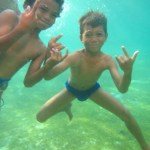
In Eastern Kalimantan, Borneo, Bajau Laut have been living for generations. Originally they arrived on houseboats from the Sulu Sea.
I visited Derawan Islands where I stayed for one week. It is a tourist paradise with excellent diving spots and fascinating sea creatures as manta rays and hawksbill sea turtles. Most people on the islands are Bajau and they speak more or less the same dialect as in Semporna, Malaysia. I was pleased to see that most children still speak Sinama – and they were spending their afternoons swimming and playing next to sea turtles in the shallow waters.


Derawan Islands consist of a large number of island, of whom two are inhabited – Pulau Derawan and Pulau Maratua. The islands are far from as exploited as for example Mabul in Semporna, and all resorts are owned and run by local people.
One of the islands, Sanalaki, is well-known for their hawksbill turtles and coral manta ray . Here visitors can swim with the giant rays and watch the turtles when they enter the beach at night laying their eggs. On the island of Kakaban you can also find a lake full of jellyfish – but they are completely harmless.
Recently, many Sama Dilaut used to stay in the area, moving between Indonesia, Philippines and Malaysia in search for fishing grounds. But today there are no nomads left, as the Indonesian government repeatedly have confiscated their boats and sent them back to Malaysia. They are not welcome as they lack legal papers.
The local people control the islands – they where empty when Bajau settled here for more than 100 years ago. “I want Sanalaki to become as Sipadan in Malaysia”, one local Bajau dive operator told me, “a tourist heaven and a sanctuary”.
The Derawan Islands are also important for the Indonesian live fish trade. From here, great numbers of lobster and groupers are transported to Surabaya on Java and Tawau in Sabah, Malaysia. Much of the fish end up on luxury restaurants in Jakarta, Singapore, Kuala Lumpur and Hong Kong.
After Derawan I am heading towards Southeast Sulawesi where I will visit Bajo Laut, who have lived in the area for hundreds of years. They are distant relatives to Bajau Laut in the Sulu Sea, but much of their lifestyle are the same. Once again I will visit the village Topa which I went to almost two years ago – following the footsteps of Erika Schagatay, who was there for more than 20 years ago.

 The Aquatic Ape